Home Entertainment Evolution: 4 Immersive Technologies Redefining Living Rooms for 2026

The concept of home entertainment has undergone a dramatic evolution over the past few decades. From black and white television sets to high-definition flat screens, and from stereo systems to surround sound, each technological leap has brought us closer to a truly immersive experience. However, what lies ahead promises to be even more groundbreaking. By 2026, our living rooms are set to be completely redefined by a confluence of cutting-edge immersive technologies that will blur the lines between reality and digital content. This isn’t just about bigger screens or louder speakers; it’s about engaging all our senses and transforming passive consumption into active, unforgettable experiences. Welcome to the future of Home Entertainment Technologies.
The convergence of advanced computing power, sophisticated sensor technology, and innovative display solutions is paving the way for an era where our homes become portals to limitless digital worlds. We are talking about experiences that go beyond mere visual and auditory stimulation, delving into tactile sensations and interactive environments that respond to our presence. This article will delve into four pivotal immersive technologies that are poised to reshape our living room experiences: Augmented Reality (AR), Virtual Reality (VR), Spatial Audio, and Haptic Feedback. Each of these technologies, individually powerful, will reach their full potential when integrated, creating a holistic and deeply engaging home entertainment ecosystem. Get ready to explore how these innovations will not only change how we watch movies or play games but also how we connect with others and interact with our personal spaces.
The Dawn of Augmented Reality in Our Living Spaces
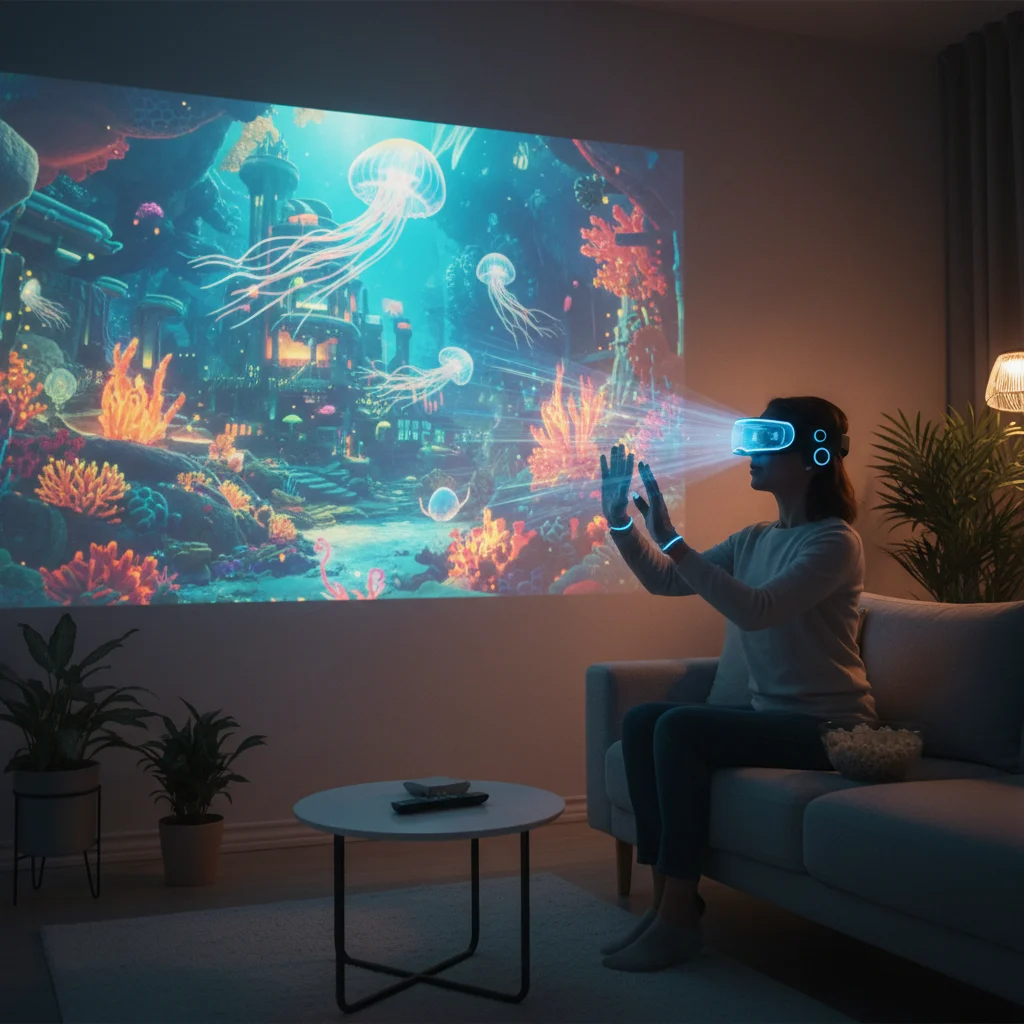
Augmented Reality (AR) has long been a subject of science fiction, but its practical applications are rapidly expanding, making it one of the most exciting Home Entertainment Technologies for the near future. Unlike Virtual Reality, which completely immerses users in a simulated environment, AR overlays digital information onto the real world. Imagine watching a nature documentary where a holographic projection of a lion walks across your living room floor, or playing a board game where animated characters spring to life on your coffee table. By 2026, these scenarios will be commonplace, transforming our homes into dynamic and interactive canvases.
The core of AR’s appeal in home entertainment lies in its ability to enhance our existing environment without isolating us from it. This means families can share AR experiences, interacting with digital content together while still being present in the same physical space. Advanced AR headsets and glasses, becoming more lightweight and stylish, will project high-definition graphics directly into our field of vision, seamlessly blending virtual objects with real-world surroundings. This technology will revolutionize how we consume media. Instead of a static screen, movies could unfold around us, with scenes expanding beyond the television frame to encompass the entire room. Educational content will become incredibly engaging, allowing learners to dissect 3D models of historical artifacts or explore virtual planets right from their sofa.
Gaming is another area where AR will shine. Imagine strategy games played out on your dining table, with miniature armies battling across real-world terrain, or interactive puzzles that utilize your furniture as part of the game board. Fitness routines could be gamified with virtual trainers appearing in your living room, guiding you through exercises and providing real-time feedback. The potential applications are vast, extending to interior design, where you can virtually place furniture before buying, or even remote work, with holographic colleagues appearing in your home office. The integration of AR into our everyday lives will make our homes smarter, more interactive, and infinitely more entertaining, truly pushing the boundaries of Home Entertainment Technologies.
Virtual Reality: A Portal to New Worlds from Your Couch
While AR enhances the real world, Virtual Reality (VR) offers a complete escape, transporting users to entirely new digital realms. The evolution of VR headsets has been rapid, moving from bulky, tethered devices to standalone, high-resolution, and increasingly comfortable units. By 2026, VR will be a central pillar of Home Entertainment Technologies, offering unparalleled immersion for gaming, cinematic experiences, and even social interactions.
The improvements in VR technology will focus on higher resolution displays, wider fields of view, and reduced latency, minimizing motion sickness and making experiences more fluid and realistic. Wireless capabilities will become standard, allowing users greater freedom of movement within their designated play spaces. Imagine stepping into a meticulously recreated historical city, exploring alien landscapes, or attending a live concert from the best seat in the house, all without leaving your living room. VR will transform passive viewing into active participation, allowing you to not just watch a story unfold, but to be a part of it.
Gaming in VR is already a transformative experience, but future advancements will bring even more realistic physics, intelligent AI, and expansive open worlds that feel truly alive. Beyond gaming, VR will revolutionize cinematic storytelling. Imagine interactive movies where your choices influence the narrative, or documentaries that allow you to walk alongside prehistoric dinosaurs. Social VR platforms will allow friends and family from across the globe to gather in virtual spaces, play games, watch movies together, or simply chat as if they were in the same room. These virtual hangouts will feel incredibly real, fostering a sense of presence and connection that traditional video calls cannot match. The accessibility and quality of VR experiences will make it an indispensable part of the modern home, offering endless possibilities for entertainment and connection as a leading Home Entertainment Technology.
Spatial Audio: Beyond Surround Sound
For decades, surround sound has been the pinnacle of audio immersion in home entertainment, creating a sense of depth and direction. However, by 2026, Spatial Audio will take this concept to an entirely new level, becoming a fundamental component of advanced Home Entertainment Technologies. Spatial Audio doesn’t just place sounds around you; it creates a three-dimensional soundscape where audio objects appear to originate from specific points in space, including above and below you, and move realistically as they would in the real world.
This technology utilizes advanced algorithms and often relies on object-based audio formats (like Dolby Atmos or DTS:X) to render sound dynamically. Instead of channels, individual sounds (like a gunshot, a bird’s chirp, or a character’s voice) are treated as objects that can be precisely positioned and moved within a virtual 3D space. When these audio objects are played back through a compatible system – whether it’s a multi-speaker setup with height channels, a soundbar with upward-firing drivers, or even specialized headphones – the result is an incredibly realistic and enveloping auditory experience.
In the context of home entertainment, Spatial Audio means that a helicopter flying overhead in a movie will not only sound like it’s above you but will also accurately track its movement across the room. In gaming, footsteps from an enemy will provide precise directional cues, enhancing both immersion and competitive advantage. For music, Spatial Audio can transport you into the recording studio or onto the stage, allowing you to perceive individual instruments and vocals with unprecedented clarity and placement. This technology will dramatically deepen the sense of presence and realism in all forms of media, making every sound contribute to a more convincing and engaging experience. As sound systems become more sophisticated and integrated into smart home ecosystems, Spatial Audio will become a standard expectation, elevating the auditory dimension of Home Entertainment Technologies to new heights.
Haptic Feedback: Feeling the Digital World
While AR, VR, and Spatial Audio engage our sight and hearing, Haptic Feedback completes the sensory quartet, allowing us to feel the digital world. This technology, which provides tactile sensations, has been present in rudimentary forms (like vibrating game controllers) for years. However, by 2026, advanced haptic feedback systems will be incredibly sophisticated, offering a nuanced range of sensations that will add an unprecedented layer of realism to Home Entertainment Technologies.
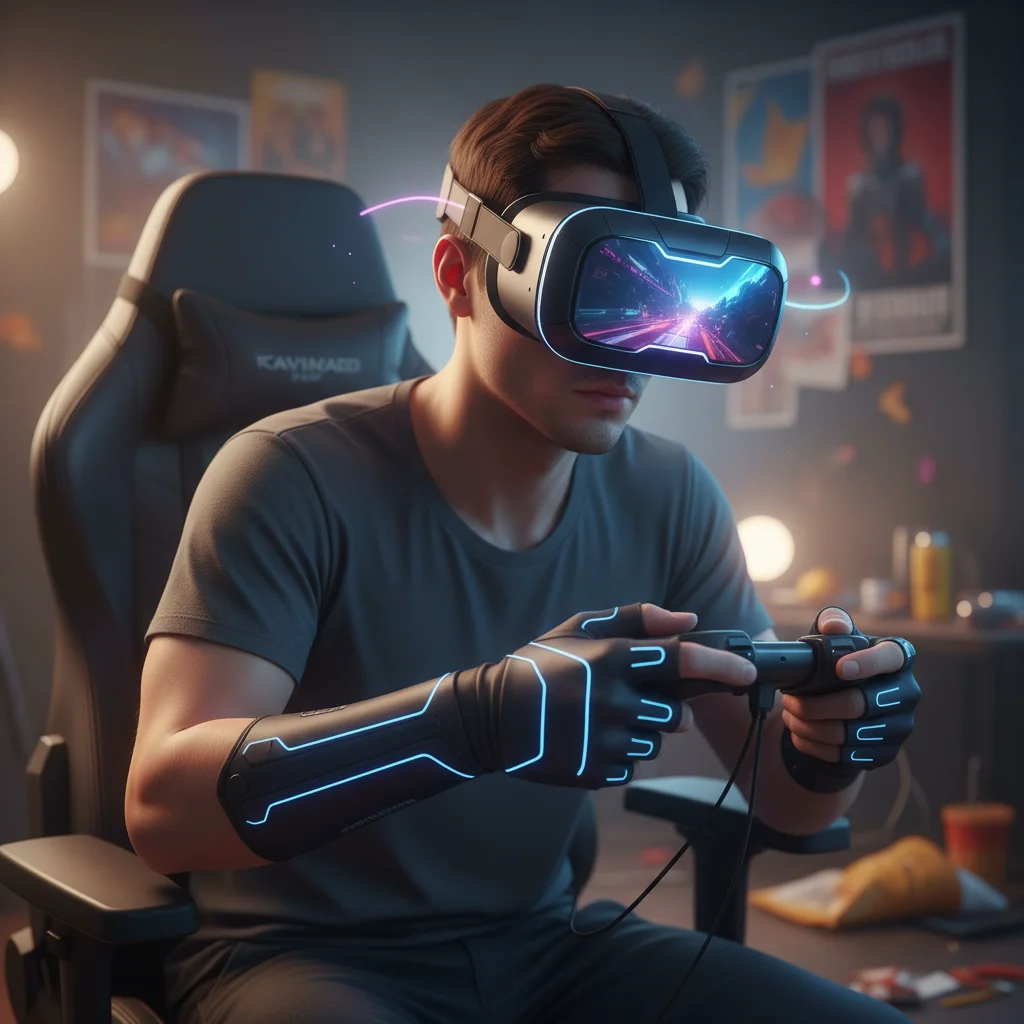
Imagine not just seeing and hearing an explosion in a movie or game, but feeling the concussive blast through your seat or even a full-body suit. Picture reaching out in VR and feeling the texture of a virtual object, the resistance of a button, or the gentle patter of rain. Advanced haptic technology goes beyond simple vibrations, employing various methods like localized pressure, temperature changes, and even electrotactile stimulation to create a wide array of sensory effects. Haptic gloves and suits will allow for precise tactile interactions within VR environments, making virtual objects feel tangible. Haptic chairs and flooring will translate on-screen action into physical sensations, adding another dimension to movies and games.
The applications for haptic feedback are extensive. In gaming, it will make every hit, every weapon recoil, and every environmental interaction feel more impactful and realistic. For cinematic experiences, it can heighten tension, emphasize dramatic moments, and truly immerse viewers in the action. Beyond traditional entertainment, haptics could play a role in training simulations, virtual tourism, and even remote communication, allowing users to feel a virtual handshake or hug. The integration of sophisticated haptic feedback will bridge the gap between the digital and physical, making virtual experiences indistinguishable from reality and solidifying its place as a transformative Home Entertainment Technology.
The Synergy: A Unified Immersive Experience
While each of these Home Entertainment Technologies—Augmented Reality, Virtual Reality, Spatial Audio, and Haptic Feedback—is powerful on its own, their true potential will be unlocked when they are seamlessly integrated. By 2026, we can expect to see home entertainment systems that combine these elements into a unified, holistic immersive experience. This synergy will create a level of presence and engagement that was previously unimaginable, transforming our living rooms into dynamic, multi-sensory environments.
Imagine a scenario where you put on a lightweight AR headset. Instead of a flat screen, your entire living room becomes the stage for a movie. Spatial Audio ensures that dialogue emanates from characters as they move around your physical space, while environmental sounds like rain or distant thunder fill the room from realistic directions. As a character touches something on screen, subtle haptic feedback from a smart cushion or integrated haptic flooring might give you a gentle sensation. If the scene shifts to a completely different environment, you might transition into a VR experience, fully transported to a new world where haptic gloves allow you to interact with virtual objects and spatial audio places you right in the heart of the action.
This integrated approach means that entertainment will no longer be confined to a screen. It will be an environment that reacts to you, an experience that you can feel, hear, and see all around you. This level of immersion will not only revolutionize how we consume media but also how we interact with technology itself. Smart home systems will become more intuitive, responding to gestures, voice commands, and even eye movements within these immersive environments. Connecting with friends and family will take on new dimensions, allowing for shared virtual experiences that feel remarkably real. The lines between entertainment, communication, and daily life will increasingly blur, leading to a richer, more interactive existence within our homes.
Challenges and the Path Forward for Home Entertainment Technologies
While the future of Home Entertainment Technologies looks incredibly bright, the path to widespread adoption and seamless integration isn’t without its challenges. Key hurdles include the cost of advanced hardware, the need for robust content ecosystems, user comfort and accessibility, and ensuring privacy and data security within these highly immersive environments.
Affordability remains a significant factor. For these technologies to become truly mainstream by 2026, the price points for high-quality AR glasses, VR headsets, and haptic feedback systems must become more accessible to the average consumer. Manufacturers are constantly working on economies of scale and more efficient production methods, but striking the right balance between cutting-edge performance and consumer-friendly pricing is crucial. Furthermore, the development of compelling content is paramount. Without a rich library of AR applications, VR games, spatial audio mixes for films, and haptically-enhanced experiences, even the most advanced hardware will struggle to gain traction. Content creators, studios, and developers must embrace these new mediums and innovate in storytelling and interaction design to fully leverage the capabilities of these immersive technologies.
User comfort and accessibility are also vital. AR glasses need to be lightweight and fashionable enough for extended wear, while VR headsets must offer clear optics, wide fields of view, and minimal motion sickness for a broad audience. Haptic feedback needs to be nuanced and realistic without being jarring or uncomfortable. Design must prioritize ease of use, ensuring that people of all ages and technical proficiencies can enjoy these experiences without significant learning curves. Finally, as these technologies become more integrated into our personal spaces and gather more data about our interactions and environments, robust privacy protocols and data security measures will be essential to build user trust and ensure responsible innovation. Addressing these challenges will be key to unlocking the full potential of these transformative Home Entertainment Technologies and making them a staple in every modern home.
The Impact on Lifestyle and Social Interaction
The evolution of Home Entertainment Technologies, particularly the immersive kind, will extend far beyond simply how we consume media. It will profoundly impact our lifestyles, social interactions, and even our perception of reality. By 2026, our homes will not just be places of rest, but dynamic hubs for creativity, learning, and connection, all facilitated by these advanced technologies.
Consider the transformation of social interaction. While some might fear that immersive tech could lead to isolation, it’s more likely to foster new forms of connection. Imagine attending a virtual family gathering where distant relatives feel truly present in the same digital space, sharing laughs and experiences as if they were physically there. Collaborative AR environments could allow friends to co-create art, design virtual spaces, or even work on projects together in real-time, regardless of geographical distance. The shared experiences offered by VR and AR will create new avenues for social bonding, making long-distance relationships feel much closer.
Furthermore, these technologies will democratize access to experiences that were once exclusive. Want to visit the Louvre, climb Mount Everest, or attend a concert by your favorite band? VR will make these experiences accessible from your living room. Educational opportunities will be boundless, allowing for immersive field trips to historical sites or scientific laboratories that were previously out of reach. Fitness and wellness will also see a revolution, with personalized AR and VR training programs that adapt to your environment and progress, making exercise more engaging and effective. The home will become a central point for a diverse array of activities, blurring the lines between work, play, learning, and social life. This profound shift will redefine what it means to live in the digital age, with Home Entertainment Technologies leading the charge in shaping our future lifestyles.
Conclusion: A Future Redefined by Immersive Home Entertainment
The trajectory of Home Entertainment Technologies is clear: towards deeper immersion, greater interaction, and a seamless blend of the digital and physical worlds. By 2026, the foundational elements of this future—Augmented Reality, Virtual Reality, Spatial Audio, and advanced Haptic Feedback—will have matured to a point where they are not just novelties but integral components of our daily lives. Our living rooms will transform from passive viewing spaces into active, multi-sensory environments that cater to every whim of entertainment, education, and social connection.
This revolution promises experiences that are not merely watched or heard, but truly felt and lived. Movies will become interactive journeys, games will achieve unprecedented realism, and communication will transcend geographical boundaries, fostering a sense of presence unlike anything before. While challenges in cost, content development, and user experience still need to be addressed, the rapid pace of innovation suggests that these hurdles will be overcome, making these transformative technologies accessible to a broad audience.
The future of home entertainment is not just about consuming content; it’s about becoming an active participant in dynamic, evolving digital worlds that blend effortlessly with our physical surroundings. As we look towards 2026, the living room is poised to become the epicenter of this technological renaissance, offering unparalleled experiences that will redefine our understanding of entertainment and enrich our lives in ways we are only just beginning to imagine. Prepare to step into a new era where your home is your ultimate portal to limitless possibilities, all powered by these incredible Home Entertainment Technologies.