SCAMPER Method: Innovate Your Product Ideas in 1 Hour

In the dynamic landscape of American entrepreneurship, the ability to consistently generate fresh, innovative product ideas is not just an advantage; it’s a necessity. The market is saturated, consumer demands are ever-evolving, and competitors are always on the hunt for the next big thing. For US entrepreneurs, staying ahead means embracing systematic approaches to creativity. This is where the SCAMPER method innovation comes into play – a powerful, yet simple, brainstorming technique designed to spark creativity and generate a multitude of new product ideas in a remarkably short amount of time. Imagine being able to walk into a room with a product or service, apply a structured thinking process, and walk out an hour later with ten or more viable new concepts. This isn’t just a dream; it’s a tangible outcome achievable through the diligent application of the SCAMPER method.
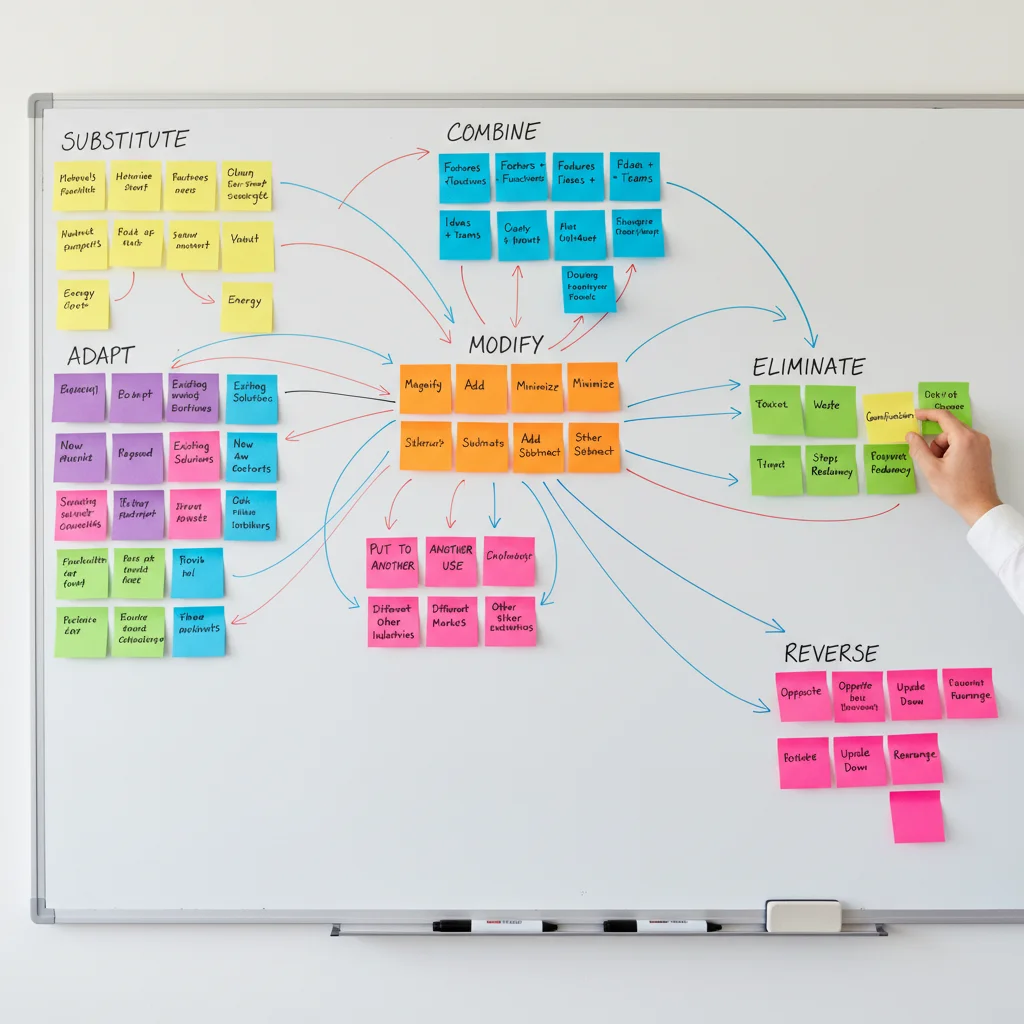
The SCAMPER method is more than just an acronym; it’s a strategic framework that encourages you to look at existing products, services, or problems from seven different perspectives. Each letter in SCAMPER represents a prompt for creative thinking: Substitute, Combine, Adapt, Modify (Magnify/Minify), Put to another use, Eliminate, and Reverse (Rearrange). By systematically asking questions related to each of these prompts, you can dismantle conventional thinking, challenge assumptions, and unlock a torrent of innovative possibilities. This guide is tailored specifically for US entrepreneurs, providing a step-by-step roadmap to harness the full potential of the SCAMPER method, ensuring you not only generate ideas but also refine them into actionable product concepts that resonate with the American market.
We’ll delve deep into each component of SCAMPER, offering practical examples relevant to the US market, and demonstrating how you can integrate this method into your regular product development cycles. Whether you’re a startup founder looking for your breakthrough product, an established business aiming to diversify your offerings, or an individual inventor seeking to refine an existing idea, the principles outlined here will equip you with the tools to innovate effectively and efficiently. This isn’t about random brainstorming; it’s about directed, strategic creativity that yields tangible results. Let’s embark on this journey to master the SCAMPER method innovation and transform your approach to product development.
Understanding the Core of SCAMPER: A Framework for Breakthroughs
Before we dive into the practical application, it’s crucial to understand the philosophy behind the SCAMPER method. Developed by Bob Eberle, based on Alex Osborn’s original idea checklist, SCAMPER provides a structured way to think outside the box without feeling overwhelmed by the sheer vastness of creative possibilities. It acts as a set of prompts, guiding your thought process and ensuring you explore every angle of a product or service. The beauty of the SCAMPER method innovation lies in its simplicity and its capacity to be applied to almost anything – a physical product, a digital service, a business process, or even a marketing campaign. For US entrepreneurs, this versatility is invaluable, allowing for broad application across various industries and business models.
Why SCAMPER is Essential for US Entrepreneurs
- Breaks Creative Blocks: When you hit a wall, SCAMPER offers specific questions to restart your creative flow.
- Systematic Innovation: It transforms abstract creativity into a systematic process, making innovation repeatable and predictable.
- Market Responsiveness: By prompting you to consider different uses and adaptations, it helps identify new market niches and consumer needs.
- Competitive Edge: Consistently generating new ideas keeps your business fresh and ahead of the competition.
- Resource Optimization: Often, SCAMPER helps find new uses for existing resources, reducing the need for entirely new investments.
The goal is not just to generate ideas, but to generate relevant and actionable ideas. Each question within the SCAMPER framework forces you to critically evaluate your product or service, pushing you beyond obvious solutions to truly innovative concepts. This structured approach is particularly beneficial for US entrepreneurs who often operate in fast-paced, highly competitive environments where time and resources are precious. Leveraging the SCAMPER method innovation means maximizing your creative output with minimal wasted effort.
Step-by-Step Guide: Applying Each SCAMPER Element
Now, let’s break down each element of the SCAMPER method and provide actionable steps and examples relevant to US entrepreneurs. Remember, the key is to pick a product, service, or problem you want to innovate on, and then systematically apply each of the seven prompts. Don’t censor ideas; jot down everything that comes to mind, no matter how outlandish it may seem initially.
1. S – Substitute: What Can You Replace?
The ‘Substitute’ prompt asks you to consider what parts of your product, service, or process can be replaced with something else. This could involve materials, ingredients, power sources, people, places, or even the underlying process. The aim is to find alternatives that might improve efficiency, reduce cost, enhance quality, or appeal to a different market segment.
Questions to Ask:
- What materials or resources can be substituted?
- Can the power source be changed?
- What other process or method could be used?
- Who else could do this?
- What if we use a different approach or strategy?
- Can we substitute a person, place, or thing?
US Entrepreneurial Examples:
- Coffee Shop: Substitute plastic cups with compostable or reusable ones (sustainability trend).
- Software Service: Substitute manual data entry with AI-driven automation.
- Delivery Service: Substitute traditional vehicles with electric bikes or drones for certain routes.
- Fashion Brand: Substitute synthetic fabrics with organic cotton or recycled materials.
By focusing on substitution, you can often find ways to make your product more eco-friendly, cost-effective, or accessible, tapping into new consumer values prevalent in the US market. This initial step of the SCAMPER method innovation often uncovers low-hanging fruit for improvement.
2. C – Combine: What Can You Bring Together?
The ‘Combine’ prompt encourages you to merge two or more elements of your product, service, or business model to create something new and more valuable. This could involve combining features, functions, ideas, or even different products or services. The goal is to create synergy, offering a more comprehensive or unique solution.
Questions to Ask:
- What ideas, features, or components can be combined?
- Can we merge purposes or objectives?
- What if we combine two existing products into one?
- How can we combine talents or resources?
- What synergistic effects can we create?
US Entrepreneurial Examples:
- Fitness App: Combine workout tracking with personalized meal planning and a social community feature.
- Home Security: Combine smart locks with a video doorbell and remote monitoring services.
- Co-working Space: Combine office amenities with a childcare facility.
- Online Retailer: Combine subscription box services with augmented reality try-on features.
Combining elements often leads to ‘hybrid’ products or services that address multiple customer needs simultaneously, creating a stronger value proposition and expanding your market reach. This is a powerful aspect of the SCAMPER method innovation for generating novel concepts.
3. A – Adapt: What Can You Adjust or Borrow?
The ‘Adapt’ prompt asks you to consider what you can adjust, modify, or borrow from other products, services, or contexts and apply to your own. This isn’t about direct copying, but rather drawing inspiration from successful concepts in different industries or situations and adapting them to fit your specific needs. It’s about finding parallels and applying learning.
Questions to Ask:
- What else is like this?
- What ideas from other industries can be adapted?
- How can we adapt to a different context or market?
- What processes or solutions can we borrow?
- What historical precedents can we adapt?
US Entrepreneurial Examples:
- Food Truck: Adapt the fine-dining experience to a casual, mobile setting.
- E-learning Platform: Adapt gamification techniques from video games to improve student engagement.
- Healthcare Service: Adapt subscription models from software companies to offer preventative care packages.
- Retail Store: Adapt ‘showrooming’ concepts from online retailers to allow customers to experience products before buying online.
Adaptation is a cornerstone of innovation, enabling US entrepreneurs to leverage proven concepts and tailor them to create unique offerings. This step in the SCAMPER method innovation is about smart borrowing and creative transformation.
4. M – Modify (Magnify/Minify): What Can You Change, Enlarge, or Reduce?
The ‘Modify’ prompt is broad, encompassing making changes to the product or service. This includes ‘Magnify’ (making something bigger, stronger, more frequent, adding features) and ‘Minify’ (making something smaller, lighter, less frequent, simpler, removing features). It’s about altering attributes to create new value or appeal.
Questions to Ask:
- What can be magnified or made stronger?
- What can be miniaturized or made lighter?
- What can be changed in terms of color, shape, sound, or form?
- What new features can be added?
- What can be simplified or streamlined?
US Entrepreneurial Examples:
- Smartphone: Magnify camera capabilities, minify bezel size.
- Home Cleaning Service: Magnify eco-friendly practices, minify the time customers spend booking.
- Restaurant: Modify the menu to focus on a niche cuisine (e.g., vegan comfort food), magnify the dining experience with unique ambiance.
- Financial Service: Minify complex legal jargon into easily understandable terms, magnify personalization through AI advisors.
This stage of the SCAMPER method innovation is incredibly fertile for generating diverse ideas, as it allows for both incremental improvements and radical redesigns by playing with various aspects of the product or service.
5. P – Put to Another Use: How Can It Be Used Differently?
The ‘Put to another use’ prompt challenges you to think about how your product or service, or even its components, could be utilized in entirely different ways or for different purposes than originally intended. This often uncovers new markets or expands the utility of your existing offering.
Questions to Ask:
- What other uses could this product have?
- Can it be used by other people or for a different purpose?
- How can we repurpose waste or by-products?
- Can it be used in a different context or environment?
- What if we target a completely different customer segment?
US Entrepreneurial Examples:
- Old Shipping Containers: Repurpose into pop-up shops, affordable housing units, or vertical farms.
- Social Media Platform: Initially for personal connections, put to another use for business networking or political campaigning.
- Car Manufacturing Plant: Put to another use for producing medical equipment during a crisis.
- Waste Heat from Data Centers: Put to another use for heating nearby buildings or greenhouses.
This element of the SCAMPER method innovation is particularly effective for finding hidden value in existing resources and for identifying entirely new customer segments or market opportunities that were previously overlooked. It encourages a highly resourceful mindset, which is a hallmark of successful US entrepreneurs.
6. E – Eliminate: What Can You Remove or Simplify?
The ‘Eliminate’ prompt focuses on simplifying your product or service by removing unnecessary components, features, steps, or costs. The goal is to streamline, reduce complexity, increase efficiency, or lower prices, often leading to a more focused and appealing offering.
Questions to Ask:
- What can be removed or omitted?
- What features are unnecessary?
- How can we simplify the process or design?
- What if we eliminate a step in the service delivery?
- What can be reduced in terms of time, effort, or cost?
US Entrepreneurial Examples:
- Fast Food Restaurant: Eliminate dine-in service to focus solely on drive-thru and delivery (ghost kitchens).
- Software Application: Eliminate complex features rarely used by the majority of users to create a more intuitive interface.
- Retail Experience: Eliminate cashiers with self-checkout or automated payment systems.
- Subscription Box: Eliminate excessive packaging to reduce waste and shipping costs.
Elimination often leads to a clearer value proposition, lower operational costs, and a more user-friendly experience, making it a critical aspect of the SCAMPER method innovation. Sometimes, less truly is more, especially in a market craving simplicity and efficiency.
7. R – Reverse (Rearrange): What Can You Invert or Reorder?
The ‘Reverse’ or ‘Rearrange’ prompt asks you to consider doing the opposite of what’s currently done, or changing the order of things. This can lead to completely new perspectives and innovative solutions by challenging the established norms and assumptions about how a product or service should function.
Questions to Ask:
- What if we do the exact opposite?
- How can we reverse the process or sequence?
- What if we swap roles or responsibilities?
- What would happen if we turned it inside out or upside down?
- How can we rearrange the components or structure?
US Entrepreneurial Examples:
- Traditional Retail: Reverse the model by letting customers design their own products online before manufacturing (customization platforms).
- Job Application Process: Reverse by having companies apply to candidates (talent marketplace platforms).
- Customer Service: Reverse from reactive support to proactive problem-solving based on predictive analytics.
- Education: Reverse the classroom model, with lectures online and homework done in class (flipped classroom).
Reversing or rearranging can be a powerful catalyst for disruptive innovation, forcing you to reconsider fundamental aspects of your business and leading to radically new approaches that can redefine market categories. This final step of the SCAMPER method innovation often yields the most surprising and groundbreaking ideas.
Putting It All Together: Your One-Hour Innovation Sprint
Now that you understand each component, let’s outline how a US entrepreneur can realistically generate 10+ new product ideas in just one hour using the SCAMPER method innovation. The key is preparation, focus, and a willingness to embrace all ideas.
Preparation (10 Minutes):
- Choose Your Focus: Select one specific product, service, or business challenge you want to innovate on. Be precise. For example, instead of ‘our software,’ choose ‘our customer onboarding process.’
- Gather Your Tools: Have a timer, a notepad or whiteboard, and plenty of pens or markers ready. If working with a team, ensure everyone has their own.
- Set the Stage: Find a quiet, distraction-free environment. Explain the SCAMPER method briefly to any team members.
The SCAMPER Sprint (45 Minutes):
Allocate roughly 5-7 minutes per SCAMPER letter. Set a timer for each segment to maintain momentum. The goal is quantity over quality at this stage. Don’t stop to evaluate; just generate.
- S – Substitute (5-7 minutes): Brainstorm as many substitutions as possible. Jot down every idea.
- C – Combine (5-7 minutes): Think about what can be combined. Don’t be afraid of seemingly disparate combinations.
- A – Adapt (5-7 minutes): Look outside your industry. What works elsewhere that you can adapt?
- M – Modify (5-7 minutes): Play with size, shape, color, features. Magnify some, minify others.
- P – Put to Another Use (5-7 minutes): How else can this be used? Who else could use it?
- E – Eliminate (5-7 minutes): What can be removed? What makes it simpler?
- R – Reverse/Rearrange (5-7 minutes): What if we did the opposite? What if the order was different?
During this phase, encourage wild ideas. The more diverse and numerous your ideas, the higher the chance of finding a gem. The disciplined application of the SCAMPER method innovation in this sprint format is what makes it so effective for US entrepreneurs short on time.
Review and Refine (5 Minutes):
Once the 45 minutes are up, you should have a significant list of raw ideas. Take the last 5 minutes to quickly scan through them.
- Highlight Promising Ideas: Circle or mark the ideas that seem most interesting, innovative, or feasible. Aim for 10-15 initial promising concepts.
- Quick Prioritization: Briefly consider which ideas might have the most market potential or align with your business goals.
This one-hour sprint is not about fully developed business plans; it’s about rapidly expanding your pool of possibilities. The ideas generated through this focused application of the SCAMPER method innovation will then serve as the foundation for further research, validation, and development.
Beyond the Hour: Validating and Developing Your SCAMPER Ideas
Generating ideas is just the first step. For US entrepreneurs, the real work begins in validating and developing these concepts into viable products or services. The SCAMPER method innovation provides the raw material; now you need to sculpt it.
1. Market Research and Validation:
For each promising idea generated, conduct preliminary market research. Is there a genuine need for this product or service in the US market? Who is the target customer? What are competitors offering? Use surveys, interviews, and focus groups to gather feedback. Look for pain points your new idea can solve.
2. Feasibility Analysis:
Evaluate the technical, financial, and operational feasibility of each idea. Do you have the resources, expertise, and capital to bring it to life? If not, what would be required? Consider potential challenges and risks.
3. Prototyping and Testing:
For the most promising ideas, create a minimum viable product (MVP) or a simple prototype. Get it into the hands of potential users and gather feedback. Iterate based on their input. This lean approach is crucial for US entrepreneurs to minimize risk and maximize learning.
4. Business Model Development:
Develop a clear business model for your chosen ideas. How will you generate revenue? What is your pricing strategy? How will you market and distribute your product? A solid business plan is essential for attracting investment and ensuring long-term success.
5. Continuous Innovation:
Innovation is not a one-time event. Make the SCAMPER method innovation a regular part of your business operations. Schedule regular innovation sprints, encourage your team to use the framework, and foster a culture that values continuous improvement and creative problem-solving.
Common Pitfalls and How to Avoid Them
While the SCAMPER method is remarkably effective, there are common traps that US entrepreneurs can fall into. Being aware of these can help you maximize your success.
- Censoring Ideas Too Early: The biggest mistake is to judge ideas as ‘good’ or ‘bad’ during the generation phase. The goal is quantity. Evaluation comes later.
- Lack of Specificity: Applying SCAMPER to a vague problem statement (‘our business’) will yield vague ideas. Be specific about what you’re trying to innovate.
- Not Dedicating Enough Time: While it’s a one-hour sprint, that hour needs to be focused and uninterrupted. Multitasking will diminish results.
- Failing to Follow Through: Generating ideas is fun, but without subsequent validation and development, they remain just ideas.
- Ignoring Market Needs: Innovation for innovation’s sake is rarely successful. Ensure your ideas address a real problem or need in the US market.
By avoiding these pitfalls, US entrepreneurs can ensure that their application of the SCAMPER method innovation is as productive and impactful as possible, leading to truly valuable and market-ready products.
Conclusion: Empowering US Entrepreneurs Through SCAMPER
The ability to innovate rapidly and effectively is a cornerstone of success for any entrepreneur in the United States. The SCAMPER method innovation offers a proven, structured, and highly efficient approach to unlock creative potential, generate a wealth of new product ideas, and maintain a competitive edge. By systematically questioning, challenging, and reimagining existing concepts, you can break free from conventional thinking and discover groundbreaking opportunities.
This step-by-step guide has provided you with the knowledge and tools to conduct your own one-hour innovation sprint, yielding over 10 promising product ideas. Remember that the journey doesn’t end with idea generation; it’s merely the exciting beginning. The subsequent stages of validation, development, and continuous iteration are equally crucial for transforming these raw ideas into market-ready successes that resonate with US consumers.
Embrace the SCAMPER method as a fundamental part of your entrepreneurial toolkit. Cultivate a culture of continuous innovation within your organization, and empower yourself and your team to consistently explore new possibilities. The future of your business hinges on your capacity to adapt, evolve, and innovate. With the SCAMPER method innovation, you are not just brainstorming; you are strategically building the next generation of products and services that will define tomorrow’s American market. Start your SCAMPER sprint today and witness the transformative power of structured creativity.