Unlock Innovation: Advanced Ideation Frameworks for US Businesses

Beyond the Obvious: 4 Advanced Ideation Frameworks Delivering 20% More Unique Concepts for US Businesses This Year
In the fiercely competitive landscape of US business, continuous innovation isn’t just an advantage; it’s a necessity. Companies are constantly striving to differentiate themselves, capture new markets, and solve complex problems. However, relying on traditional brainstorming alone often leads to incremental improvements rather than truly disruptive ideas. The challenge lies in moving beyond the obvious, tapping into untapped creative potential, and generating concepts that genuinely stand out. This is where advanced ideation frameworks come into play. These structured approaches provide a systematic way to foster creativity, challenge assumptions, and uncover insights that might otherwise remain hidden.
For US businesses aiming to boost their unique concept generation by 20% or more this year, adopting sophisticated ideation methodologies is paramount. This article will delve into four powerful advanced ideation frameworks: Design Thinking, TRIZ (Theory of Inventive Problem Solving), Systematic Inventive Thinking (SIT), and Biomimicry. Each framework offers a distinct lens through which to approach problem-solving and innovation, promising to unlock a new level of creative output and strategic advantage.
The Imperative for Advanced Ideation in the Modern Business Climate
The pace of change in the US market is unprecedented. Technological advancements, shifting consumer behaviors, and global economic pressures demand more than just incremental innovation. Businesses need to be agile, adaptive, and, most importantly, consistently generate novel solutions. Traditional methods, while useful for initial concept generation, often struggle to break free from conventional thinking. This leads to "groupthink," where ideas converge rather than diverge, limiting true innovation.
Advanced ideation frameworks address these limitations by providing structured techniques that:
- Encourage diverse perspectives: By bringing together individuals from different backgrounds and disciplines, these frameworks ensure a broader range of insights.
- Challenge assumptions: They push teams to question the status quo and explore unconventional solutions.
- Systematize creativity: Rather than waiting for a flash of inspiration, these methods provide repeatable processes for generating ideas on demand.
- Focus on user needs: Many frameworks emphasize deep understanding of the end-user, ensuring that generated concepts are relevant and valuable.
- Reduce risk: By fostering a culture of experimentation and iteration, they allow businesses to test and refine ideas before significant investment.
Implementing these frameworks can transform a company’s approach to innovation, moving it from reactive problem-solving to proactive opportunity creation. This strategic shift is crucial for maintaining a competitive edge and achieving sustainable growth in the dynamic US market.
1. Design Thinking: Empathy-Driven Innovation
Design Thinking is perhaps one of the most widely recognized and effective advanced ideation frameworks for fostering human-centered innovation. Originating from the design world, it’s a non-linear, iterative process that seeks to understand users, challenge assumptions, redefine problems, and create innovative solutions to prototype and test. Its core strength lies in its emphasis on empathy, ensuring that solutions are not just technically feasible or economically viable, but also desirable to the end-user.
Phases of Design Thinking:
- Empathize: This initial phase involves deep understanding of the user’s needs, behaviors, motivations, and pain points. Techniques include interviews, observations, ethnographic studies, and creating user personas. The goal is to step into the user’s shoes and gain a profound appreciation for their experience.
- Define: Based on the insights gathered during the empathize phase, the team articulates a clear, user-centered problem statement. This isn’t about defining a solution, but rather framing the challenge in a way that inspires innovation. For example, instead of "We need to build a new app," it might be "How might we help busy professionals manage their daily tasks more efficiently?"
- Ideate: This is the brainstorming phase where teams generate a wide range of creative solutions to the defined problem. The emphasis is on quantity over quality, encouraging wild ideas and deferring judgment. Techniques like brainstorming, brainwriting, mind mapping, SCAMPER, and "Worst Possible Idea" are commonly used to push creative boundaries.
- Prototype: Selected ideas are transformed into tangible prototypes, which can be anything from a simple sketch, a storyboard, a role-play scenario, to a low-fidelity digital mockup. The purpose is to make ideas concrete and testable, allowing for quick feedback and iteration.
- Test: Prototypes are tested with real users to gather feedback. This phase is crucial for learning what works, what doesn’t, and what needs improvement. It’s an opportunity to refine solutions and iterate on the design, often leading back to earlier phases of the process.
Why Design Thinking Excels for US Businesses:
- Customer-Centricity: In a market driven by consumer choice, Design Thinking ensures that solutions directly address real user needs, leading to higher adoption rates and customer satisfaction.
- Reduced Risk: Early prototyping and testing allow for quick validation of ideas, minimizing the risk of investing in products or services that ultimately fail to meet market demand.
- Cross-Functional Collaboration: It naturally brings together diverse teams, breaking down silos and fostering a culture of shared problem-solving.
- Adaptability: Its iterative nature makes it highly adaptable to changing market conditions and user feedback, crucial for dynamic US industries.
By embedding Design Thinking into their innovation process, US businesses can move beyond superficial solutions to create truly meaningful and impactful products, services, and experiences.
2. TRIZ (Theory of Inventive Problem Solving): Engineering Innovation
TRIZ, an acronym for the Russian "Teoriya Resheniya Izobretatelskikh Zadatch," or Theory of Inventive Problem Solving, is a powerful methodology developed by Genrich Altshuller and his colleagues. Unlike Design Thinking, which is human-centered, TRIZ is rooted in engineering principles and a vast analysis of patents to identify patterns of invention. It’s a highly structured advanced ideation framework designed to overcome technical contradictions and accelerate the invention process, making it particularly valuable for product development and process optimization in US manufacturing and tech sectors.
Core Concepts of TRIZ:
- Contradictions: TRIZ posits that inventive problems arise from contradictions — when improving one aspect of a system negatively impacts another. For example, making a product stronger (improving) often makes it heavier (worsening). TRIZ helps systematically resolve these contradictions.
- 39 Engineering Parameters: Altshuller identified 39 universal engineering parameters that describe most technical systems (e.g., weight, speed, reliability, shape).
- 40 Inventive Principles: He also distilled 40 inventive principles (e.g., segmentation, extraction, local quality, universality) that have been successfully used to resolve contradictions across various fields.
- Contradiction Matrix: The heart of TRIZ is the Contradiction Matrix, which maps the 39 parameters against each other. When you identify the parameters that are in contradiction, the matrix suggests specific inventive principles to apply, leading to non-obvious solutions.
- Evolutionary Patterns of Technology: TRIZ also identifies predictable patterns in how technologies evolve, allowing innovators to anticipate future developments and proactively design next-generation solutions.
Applying TRIZ in Practice:
The TRIZ process typically involves:
- Problem Formulation: Clearly define the technical problem and identify the specific conflicting parameters.
- Abstracting the Problem: Translate the specific problem into a generic TRIZ contradiction using the 39 parameters.
- Consulting the Matrix: Use the Contradiction Matrix to find the most relevant inventive principles.
- Generating Solutions: Apply the suggested principles to the specific problem, generating a range of innovative concepts.
- Evaluating and Selecting: Assess the generated solutions for feasibility, impact, and alignment with project goals.
Benefits for US Businesses:
- Breaks Mental Inertia: TRIZ forces engineers and product developers to think outside their conventional domain, leading to truly novel solutions.
- Predictable Innovation: By leveraging patterns of invention, it makes the innovation process more predictable and less reliant on trial and error.
- Stronger Patents: Solutions derived from TRIZ often embody higher levels of inventiveness, potentially leading to stronger patent protection.
- Resource Efficiency: It can significantly reduce the time and resources spent on problem-solving by guiding innovators directly towards proven inventive strategies.
For US companies struggling with persistent technical challenges or seeking to develop breakthrough products, TRIZ offers a rigorous, systematic pathway to robust and inventive solutions, making it one of the most effective advanced ideation frameworks available.
3. Systematic Inventive Thinking (SIT): Constrained Creativity
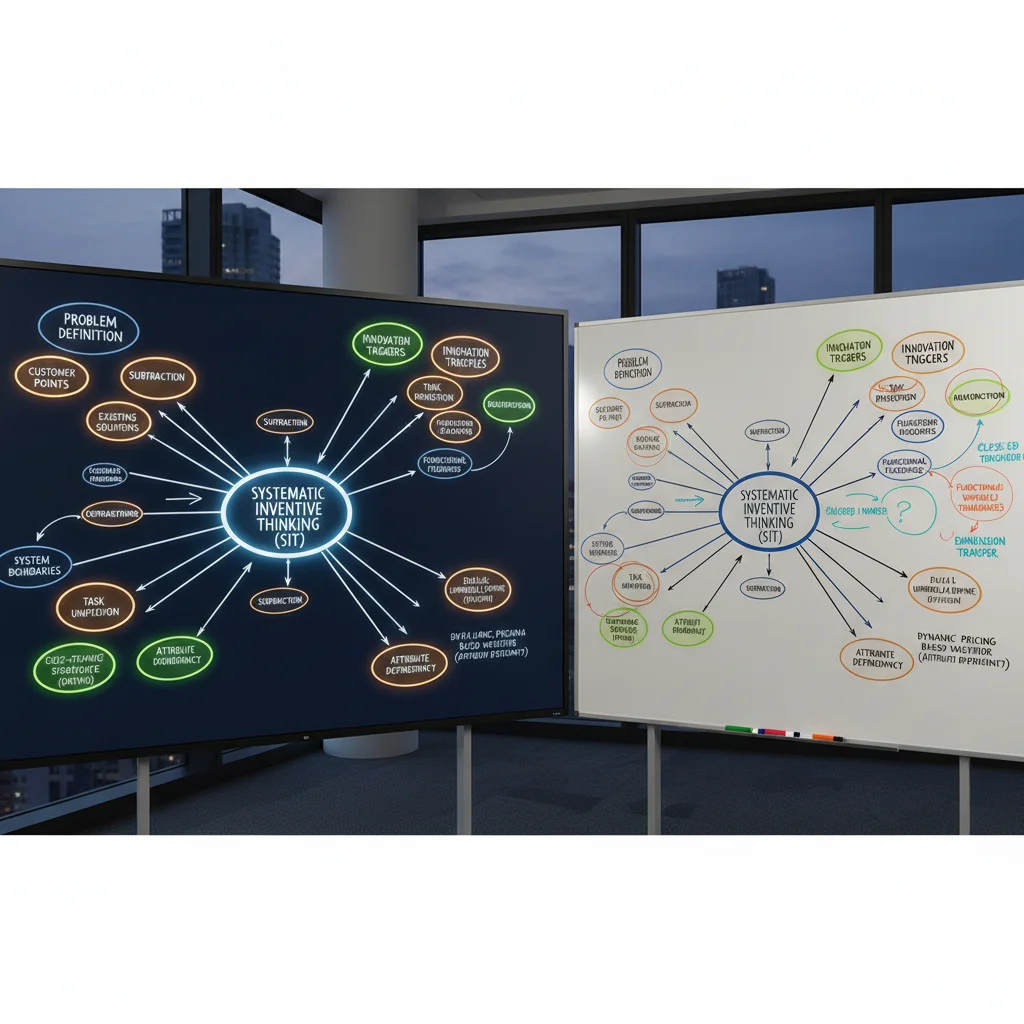
Systematic Inventive Thinking (SIT) is an Israeli-developed methodology that evolved from TRIZ but takes a different philosophical approach. While TRIZ focuses on identifying and resolving contradictions, SIT champions the idea of "Closed World" thinking and five core inventive templates. It argues that highly inventive solutions often emerge from working within existing resources and constraints, rather than seeking external components or radical changes. This makes SIT a highly practical and accessible advanced ideation framework for businesses looking for innovation within their current operational reality.
The Five Inventive Templates of SIT:
- Subtraction: Removing an essential component from a product or service and finding ways to compensate for its absence. This often leads to simpler, more efficient, or entirely new functionalities. (e.g., "cordless" tools, "no-frills" airlines).
- Multiplication: Introducing a slightly modified copy of an existing component into a product or system. The key is the "slight modification" which creates new value or addresses a new problem. (e.g., dual-core processors, multi-blade razors).
- Division: Dividing a product or service into smaller, independent, or re-arranged parts. This can involve functional division, physical division, or preserving division. (e.g., modular furniture, online course modules).
- Task Unification: Assigning a new or additional task to an existing component of a product or service. This leverages existing resources more effectively and often reduces complexity. (e.g., car spoilers that also act as brake lights, a phone that is also a camera).
- Attribute Dependency: Creating or breaking a dependency between two attributes of a product or its environment. This externalizes or internalizes a relationship, often leading to personalized or adaptive solutions. (e.g., lenses that darken in sunlight, color-changing packaging indicating freshness).
The "Closed World" Principle:
A fundamental concept in SIT is the "Closed World." This principle states that the ideal solution to a problem often resides within the problem itself or its immediate environment. Instead of looking for external solutions, SIT encourages innovators to manipulate and reconfigure existing elements. This constraint-based approach can paradoxically unlock greater creativity by forcing teams to be more ingenious with what they already have.
Advantages for US Businesses:
- Practical and Actionable: The templates provide clear, concrete starting points for ideation, making it easier for teams to generate ideas.
- Resource Optimization: By focusing on existing components, SIT encourages efficient use of current resources and capabilities.
- High Success Rate: Solutions generated through SIT often have a high probability of success because they are grounded in the existing reality of the product or service.
- Overcomes Mental Blocks: The structured templates help teams overcome common mental blocks and generate non-obvious ideas within defined parameters.
SIT is an excellent choice for US businesses seeking to innovate within existing product lines, optimize processes, or find new uses for current assets. It’s a testament to how structured constraint can lead to boundless creativity, making it a powerful addition to any innovation toolkit and a key among advanced ideation frameworks.
4. Biomimicry: Nature-Inspired Innovation
Biomimicry, derived from the Greek words "bios" (life) and "mimesis" (imitation), is an advanced ideation framework that looks to nature for sustainable and innovative solutions. It’s not just about copying nature’s forms, but about understanding and emulating its processes, strategies, and underlying principles. After 3.8 billion years of evolution, nature has already solved many of the problems we face today, from energy efficiency and material science to waste management and self-organization. By learning from nature’s genius, US businesses can develop highly efficient, resilient, and environmentally friendly products, processes, and policies.
Key Principles of Biomimicry:
- Nature as Model: Biomimicry uses an ecological lens to observe and analyze natural systems, understanding how they function and thrive.
- Nature as Measure: It evaluates the "greenness" and sustainability of human innovations against ecological standards.
- Nature as Mentor: It fosters a deeper connection to the natural world and inspires a new way of thinking about design and innovation.
Approaches to Biomimicry:
- Form-based (Copying Form): Directly imitating shapes or structures found in nature. (e.g., aerodynamic designs inspired by birds, Velcro inspired by burrs).
- Process-based (Copying Process): Emulating natural processes to create materials or systems. (e.g., self-cleaning surfaces inspired by lotus leaves, photosynthesis-inspired solar cells).
- Ecosystem-based (Copying Ecosystems): Designing systems that function like natural ecosystems, with closed loops, resource efficiency, and symbiosis. (e.g., industrial parks that share waste products, circular economy models).
The Biomimicry Process:
- Define the Challenge: Clearly articulate the problem you want to solve.
- Biologize the Challenge: Reframe the problem in biological terms. How would nature solve this?
- Discover Natural Models: Research organisms, ecosystems, or natural processes that have successfully addressed similar challenges.
- Abstract Design Principles: Identify the underlying strategies and principles that enable nature’s solutions.
- Emulate and Evaluate: Translate these principles into innovative designs, products, or services, and evaluate them against life’s principles for sustainability.
Why Biomimicry is Critical for US Businesses:
- Sustainable Innovation: It inherently leads to solutions that are more environmentally friendly, resource-efficient, and aligned with circular economy principles, meeting growing consumer and regulatory demands.
- Radical Breakthroughs: Nature’s solutions are often counter-intuitive and can lead to truly disruptive innovations not conceived through conventional human thinking.
- Enhanced Resilience: Natural systems are inherently resilient and adaptive; biomimicry can inspire designs that are more robust and durable.
- Competitive Differentiation: Products and services inspired by nature often possess unique qualities and compelling narratives that resonate with consumers.
For US businesses committed to sustainability, long-term resilience, and groundbreaking innovation, Biomimicry offers an unparalleled source of inspiration and a potent addition to their suite of advanced ideation frameworks. It moves innovation beyond human-centric needs to planet-centric solutions, a critical shift for the 21st century.
Integrating Advanced Ideation Frameworks for Maximum Impact
While each of these advanced ideation frameworks — Design Thinking, TRIZ, SIT, and Biomimicry — offers unique benefits, their true power often lies in their strategic integration. A business might start with Design Thinking to deeply understand user needs and define a problem, then use TRIZ or SIT to generate inventive technical solutions, and finally, look to Biomimicry for sustainable and elegant design inspiration.
Key Considerations for Implementation in US Businesses:
- Culture of Experimentation: Foster an organizational culture that embraces failure as a learning opportunity and encourages continuous experimentation.
- Cross-Functional Teams: Form diverse teams that bring together different perspectives, skills, and departmental knowledge.
- Dedicated Resources: Allocate time, budget, and physical space for ideation sessions and prototyping.
- Training and Facilitation: Invest in training employees on these frameworks and provide skilled facilitators to guide ideation sessions.
- Leadership Buy-in: Secure strong support from leadership, who must champion innovation and model desired behaviors.
- Iterative Process: Recognize that innovation is rarely a linear process. Be prepared to loop back, refine, and iterate based on feedback and new insights.
- Metrics for Success: Define clear metrics to measure the effectiveness of your ideation efforts, such as the number of unique concepts generated, conversion rates, market adoption, or patent filings.
For US businesses, the goal is not just to generate more ideas, but to generate *better*, more relevant, and more impactful ideas. By systematically applying these advanced ideation frameworks, companies can move from sporadic flashes of genius to a consistent, repeatable engine of innovation. This strategic shift is what will truly deliver that 20% or more increase in unique concepts, providing a sustainable competitive advantage in a rapidly evolving market.
Conclusion: Building a Future of Continuous Innovation
The future of US business success hinges on the ability to innovate consistently and effectively. Relying on outdated or insufficient ideation methods is no longer a viable strategy. By embracing advanced ideation frameworks like Design Thinking, TRIZ, Systematic Inventive Thinking, and Biomimicry, companies can systematically unlock unprecedented levels of creativity and problem-solving capability.
These frameworks provide the structure, tools, and mindset necessary to transcend conventional thinking, understand complex challenges from multiple angles, and generate truly unique, valuable, and sustainable concepts. The investment in learning and implementing these methodologies will not only yield a significant increase in innovative output — easily surpassing the 20% target for unique concepts — but also cultivate a dynamic, adaptive, and future-ready organization. It’s time for US businesses to move beyond the obvious and leverage the power of structured ingenuity to shape tomorrow’s market leaders.