Space Economy 2.0: 6 Growth Sectors in U.S. Space Industry by 2032

The dawn of Space Economy 2.0 is upon us, a transformative era marked by unprecedented innovation, commercialization, and investment in the final frontier. For decades, space exploration was primarily the domain of government agencies. Today, however, a vibrant ecosystem of private companies, venture capitalists, and entrepreneurial visionaries is reshaping the landscape, driving rapid advancements and unlocking new economic opportunities. The U.S. space industry, in particular, stands at the forefront of this revolution, poised for exponential space economy growth over the next decade.
By 2032, the U.S. space sector is projected to expand significantly, fueled by technological breakthroughs, declining launch costs, and an escalating demand for space-derived services. This isn’t merely about launching rockets; it’s about building an entire industrial complex beyond Earth, creating new markets, jobs, and capabilities that will profoundly impact life on our planet. Investors, policymakers, and industry leaders are all keenly watching this evolution, eager to identify the most promising avenues for growth and participation.
This comprehensive analysis delves into six critical sectors within the U.S. space industry that are primed for explosive space economy growth by 2032. We’ll explore the drivers behind their projected expansion, the technological innovations defining them, and the investment potential they offer. Understanding these sectors is crucial for anyone looking to navigate and capitalize on the burgeoning opportunities in Space Economy 2.0.
1. Advanced Space Launch Services: The Gateway to Orbit
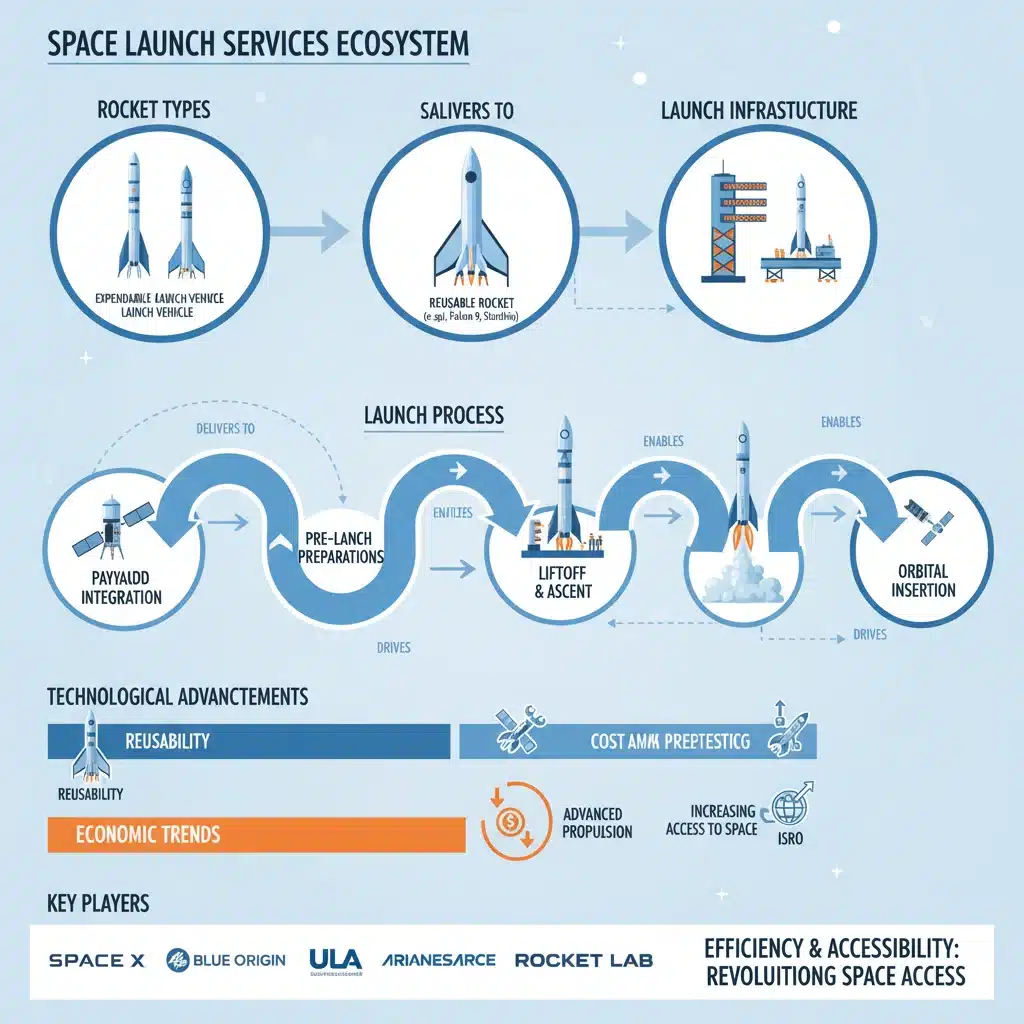
The ability to reliably and affordably access space is the bedrock of the entire space economy. Historically, launch costs were prohibitive, limiting space activities to government-funded missions. However, the advent of reusable rockets, increased competition, and innovative manufacturing techniques have dramatically driven down the price per kilogram to orbit. This trend is not only continuing but accelerating, making advanced space launch services a cornerstone of future space economy growth.
Drivers of Growth:
- Reusability: Companies like SpaceX have revolutionized the industry with Falcon 9’s reusable first stage, drastically cutting costs and increasing launch cadence. Other players are following suit, pushing the boundaries of what’s possible.
- Increased Demand for Satellites: The proliferation of mega-constellations for broadband internet, Earth observation, and IoT connectivity requires a continuous supply of launch capacity.
- Diverse Launch Vehicles: A new generation of small-lift and medium-lift rockets is emerging, catering to the specific needs of smaller satellites and offering more flexible launch schedules.
- Government and Commercial Synergy: Government agencies are increasingly relying on commercial launch providers, fostering a robust and competitive market.
Technological Innovations:
- Advanced Propulsion Systems: Development of more efficient and powerful engines, including methane-fueled rockets and electric propulsion, promises further cost reductions and increased payload capacity.
- Automated Launch Operations: Greater automation in pre-launch processing and launch execution reduces human error and speeds up turnaround times.
- Vertical Integration: Companies that design, manufacture, and launch their own rockets can achieve greater efficiencies and cost control.
By 2032, we anticipate a highly diversified launch market with multiple providers offering a range of services, from dedicated launches for heavy payloads to rideshare opportunities for smallsats. This competitive environment will continue to drive down costs and improve reliability, making space more accessible than ever before. Investment in companies developing next-generation launch vehicles, propulsion technologies, and launch infrastructure will be critical for tapping into this sector’s potential. The U.S. is uniquely positioned with a strong entrepreneurial spirit and a supportive regulatory environment to lead this charge.
2. Satellite Broadband and Connectivity: Bridging the Digital Divide
One of the most impactful areas of space economy growth is satellite broadband and connectivity. Millions worldwide still lack reliable internet access, and terrestrial infrastructure can be costly and difficult to deploy in remote or underserved areas. Satellite constellations are rapidly emerging as a scalable solution, promising to bridge the digital divide and enable global, high-speed internet access.
Drivers of Growth:
- Global Connectivity Demand: The insatiable demand for internet access, driven by remote work, education, and entertainment, continues to grow exponentially.
- Low Earth Orbit (LEO) Constellations: LEO satellites offer significantly lower latency compared to traditional geostationary satellites, making them suitable for real-time applications.
- 5G and IoT Integration: Satellite networks are becoming crucial for extending 5G coverage to rural areas and connecting billions of IoT devices globally.
- Defense and Government Applications: Secure and resilient satellite communication is vital for military operations, disaster response, and national security.
Technological Innovations:
- Phased Array Antennas: Advanced ground terminals with phased array technology allow for seamless tracking of LEO satellites and high-throughput communication.
- Inter-Satellite Links: Laser communication links between satellites reduce reliance on ground stations and improve network efficiency.
- Software-Defined Satellites: Flexible, reconfigurable satellites that can adapt to changing mission requirements and offer dynamic service allocation.
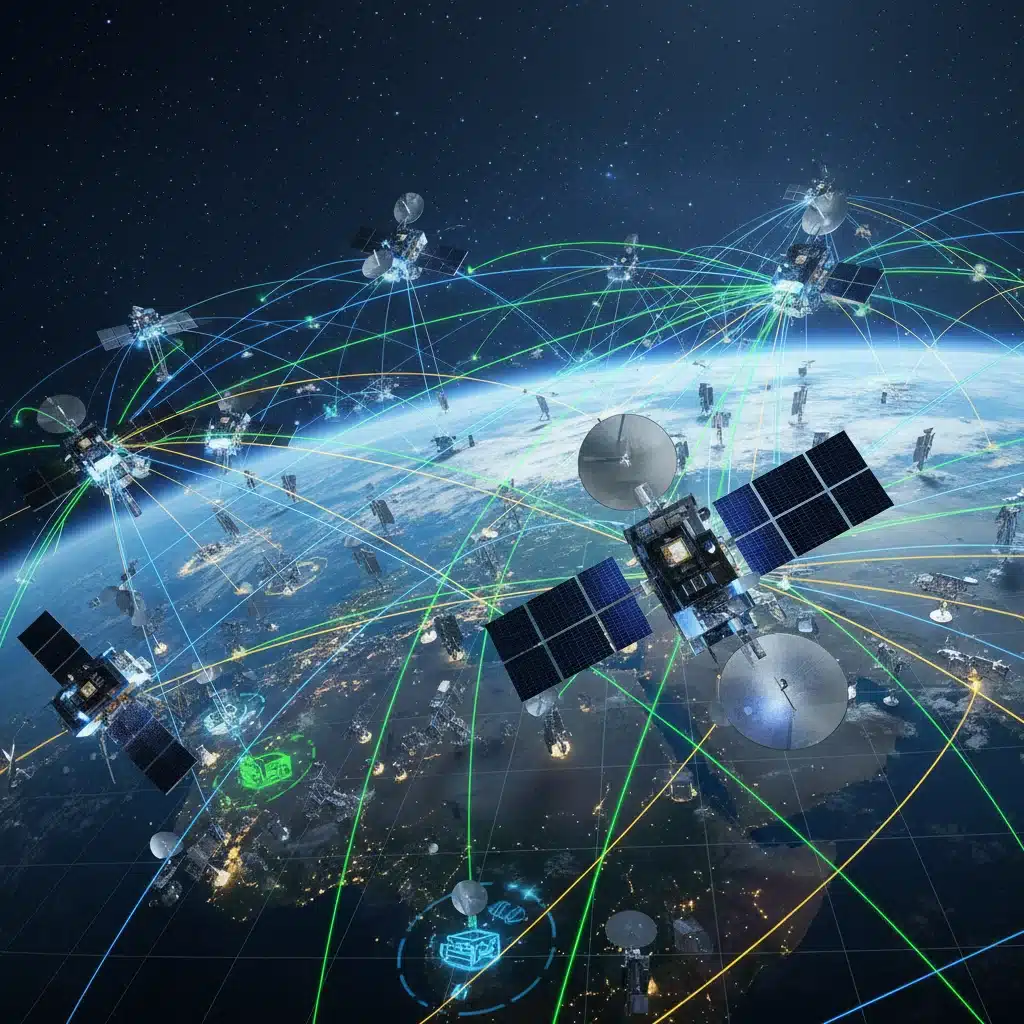
Companies like Starlink, OneWeb, and Amazon’s Project Kuiper are deploying thousands of satellites, creating a global mesh network that will transform connectivity. This sector’s growth isn’t just about providing internet; it’s about enabling new industries, fostering economic development, and empowering communities worldwide. The U.S. is a hub for many of these pioneering companies, making it a prime location for investment in this transformative aspect of the space economy growth.
3. In-Orbit Servicing, Assembly, and Manufacturing (ISAM): Sustaining and Expanding Space Operations
As the number of objects in orbit increases, so does the need for capabilities to maintain, repair, and even upgrade them. In-Orbit Servicing, Assembly, and Manufacturing (ISAM) represents a paradigm shift in how we utilize space, moving from a ‘launch and forget’ model to one of sustainability and dynamic evolution. This sector is poised for substantial space economy growth as it addresses critical challenges like space debris and limited satellite lifespans.
Drivers of Growth:
- Space Debris Mitigation: Active debris removal and satellite life extension are becoming imperative for maintaining a safe and sustainable orbital environment.
- Satellite Life Extension: Refueling, repairing, or repositioning existing satellites can extend their operational lifespan, saving billions in replacement costs.
- On-Orbit Assembly: Building larger, more complex structures in space, such as large telescopes, power stations, or even habitats, bypasses the limitations of launch vehicle fairing sizes.
- Space Resource Utilization (SRU): The long-term vision of ISAM includes using extraterrestrial resources (e.g., lunar regolith) for manufacturing in space.
Technological Innovations:
- Robotics and AI: Advanced robotic arms, autonomous rendezvous and docking systems, and AI-powered decision-making are crucial for complex in-orbit operations.
- Additive Manufacturing (3D Printing) in Space: Enabling the creation of components and structures directly in orbit, reducing the need for costly launches of pre-fabricated parts.
- Modular Satellite Design: Satellites designed with standardized interfaces for easy repair, upgrade, or module replacement.
By 2032, ISAM services will be essential for managing the growing orbital population. This includes everything from routine maintenance and repair to complex assembly of next-generation space infrastructure. Companies specializing in robotic arms, autonomous systems, and advanced materials for in-space manufacturing are leading this frontier. The U.S. government, particularly NASA and the Department of Defense, are also significant drivers of ISAM development, recognizing its strategic importance for national security and scientific exploration. This sector promises to unlock entirely new capabilities and significantly contribute to future space economy growth.
4. Earth Observation and Geospatial Intelligence: Unlocking Terrestrial Insights
Earth observation (EO) satellites have been providing invaluable data for decades, but recent advancements are transforming this sector into a powerhouse of geospatial intelligence. High-resolution imagery, synthetic aperture radar (SAR), hyperspectral imaging, and thermal sensors are collecting unprecedented amounts of data about our planet, driving significant space economy growth in areas from climate monitoring to urban planning.
Drivers of Growth:
- Big Data Analytics and AI: The ability to process and extract meaningful insights from vast datasets is unlocking new applications and commercial value.
- Climate Change Monitoring: EO data is critical for tracking climate indicators, monitoring environmental changes, and supporting climate action.
- Agriculture and Resource Management: Precision agriculture, water resource monitoring, and deforestation tracking benefit immensely from satellite imagery.
- Defense and Intelligence: High-resolution imagery and persistent surveillance are indispensable for national security and strategic intelligence.
- Commercial Applications: Industries like insurance, finance, logistics, and real estate are leveraging geospatial intelligence for risk assessment, market analysis, and operational efficiency.
Technological Innovations:
- Miniaturization of Sensors: Smaller, more powerful sensors allow for larger constellations and more frequent revisits.
- Multi-spectral and Hyperspectral Imaging: Capturing data across a broader range of the electromagnetic spectrum provides richer information about Earth’s surface and atmosphere.
- On-Board Processing: Satellites capable of processing data before transmission reduce downlink requirements and latency.
- Data Fusion: Combining data from multiple satellite sources, aerial platforms, and ground sensors for a more comprehensive view.
By 2032, Earth observation will move beyond simply providing images to delivering actionable intelligence as a service. Companies specializing in data analytics, AI-driven insights, and integrated geospatial platforms are set to thrive. The U.S. has a strong ecosystem of EO companies, from satellite operators to data analytics firms, making it a critical hub for innovation and investment in this sector, contributing significantly to global space economy growth.
5. Space Tourism and Human Spaceflight: The Ultimate Adventure
Once the exclusive domain of government astronauts, human spaceflight is rapidly becoming commercialized, opening up new possibilities for space tourism and private research missions. While still nascent, this sector holds immense potential for space economy growth, driven by human curiosity and the desire for unparalleled experiences.
Drivers of Growth:
- Decreasing Costs: Reusable launch systems and private spacecraft development are making human spaceflight more economically viable.
- Increased Demand: A growing number of high-net-worth individuals are expressing interest in suborbital and orbital space tourism.
- Private Space Stations: Future private space stations will offer destinations for tourists, researchers, and commercial activities.
- Government Support: Agencies like NASA are contracting with private companies for crew and cargo transport to the International Space Station, fostering a commercial human spaceflight market.
Technological Innovations:
- Commercial Crew Vehicles: Development of safe and reliable spacecraft designed for private passengers, such as SpaceX’s Crew Dragon and Boeing’s Starliner.
- Suborbital Flight Systems: Vehicles like Virgin Galactic’s SpaceShipTwo offering brief experiences at the edge of space.
- Advanced Life Support Systems: Innovations in closed-loop life support systems for longer-duration private missions and space habitats.
- Space Habitats and Modules: Development of inflatable modules and modular space stations for expanded orbital living and working spaces.
By 2032, we can expect to see regular suborbital tourist flights, and orbital tourism will become more established, albeit still for a select clientele. The development of private space stations will further accelerate this trend, offering more extended stays and unique experiences. Beyond tourism, commercial human spaceflight will also facilitate private research, manufacturing, and even media production in space. The U.S., with its pioneering companies like SpaceX, Blue Origin, and Virgin Galactic, is at the forefront of this exciting new frontier, making it a key area for investment in future space economy growth.
6. Space Cybersecurity and Resilience: Protecting Critical Infrastructure
As the world becomes increasingly reliant on space-based assets, the importance of protecting these critical infrastructures from cyber threats escalates. Space cybersecurity and resilience, while often overlooked, is a rapidly expanding sector crucial for the sustained space economy growth and national security. Attacks on satellites, ground stations, or data links could have devastating consequences, ranging from economic disruption to military disadvantages.
Drivers of Growth:
- Increased Attack Surface: The sheer number of satellites and ground systems, coupled with their interconnectedness, creates a larger target for malicious actors.
- Geopolitical Tensions: Nation-states and non-state actors are increasingly developing capabilities to disrupt or degrade space systems.
- Commercial Reliance: Industries from finance to logistics depend on space data and services, making their protection a commercial imperative.
- Regulatory and Compliance Demands: Governments are enacting new regulations and standards for space system cybersecurity, driving demand for specialized solutions.
Technological Innovations:
- Quantum-Resistant Cryptography: Developing encryption methods that can withstand future quantum computing attacks to secure satellite communications.
- AI-Powered Threat Detection: Using artificial intelligence and machine learning to identify and respond to cyber threats in real-time across complex space networks.
- Secure-by-Design Architectures: Integrating cybersecurity principles from the initial design phase of satellites and ground systems.
- Space Domain Awareness (SDA) for Cybersecurity: Monitoring the space environment for anomalous behavior or potential cyber intrusions.
By 2032, space cybersecurity will be a non-negotiable aspect of every space mission and infrastructure. Companies offering specialized solutions for satellite hardening, secure communication protocols, threat intelligence, and incident response will see significant demand. The U.S. Department of Defense and intelligence agencies are major drivers in this sector, but commercial entities are also rapidly investing to protect their assets and data. This sector, though less visible, is fundamental to ensuring the safety, reliability, and continued prosperity of the entire space economy growth.
Investment Potential and Challenges Ahead
The six sectors outlined above represent the vanguard of space economy growth in the U.S. by 2032. Each offers unique investment opportunities, from established giants evolving their offerings to innovative startups disrupting traditional models. Venture capital investment in space companies has soared in recent years, reflecting growing confidence in the sector’s long-term prospects. However, like any emerging industry, the space economy faces its share of challenges.
Key Investment Considerations:
- Capital Intensity: Many space ventures require significant upfront capital for R&D, manufacturing, and launch infrastructure.
- Long Development Cycles: Bringing new space technologies to market can take years, requiring patient capital.
- Regulatory Landscape: The evolving regulatory environment for space operations, licensing, and international cooperation can impact market entry and operations.
- Talent Acquisition: A specialized workforce with expertise in aerospace engineering, software development, and data science is crucial.
- Space Debris: The increasing amount of orbital debris poses a threat to operational satellites and future missions, necessitating robust mitigation strategies.
Despite these challenges, the trajectory for space economy growth remains overwhelmingly positive. The increasing confluence of government support, private investment, and technological innovation is creating a powerful engine for expansion. The U.S. is particularly well-positioned, boasting a rich history in space, a robust entrepreneurial ecosystem, and significant government backing through agencies like NASA, the Department of Defense, and the Department of Commerce.
Conclusion: A New Frontier of Economic Opportunity
The U.S. space industry is undergoing a profound transformation, moving beyond exploration to establish a vibrant, commercially driven economy. The identified six growth sectors—Advanced Space Launch Services, Satellite Broadband and Connectivity, In-Orbit Servicing, Assembly, and Manufacturing, Earth Observation and Geospatial Intelligence, Space Tourism and Human Spaceflight, and Space Cybersecurity and Resilience—are not just buzzwords; they represent tangible areas where significant investment, innovation, and job creation will occur over the next decade.
By 2032, the impact of this accelerated space economy growth will be felt across numerous industries on Earth, from global communication and climate monitoring to advanced manufacturing and unprecedented travel experiences. For investors, entrepreneurs, and policymakers, understanding these trends is paramount. The new space economy offers not just financial returns but also the opportunity to contribute to a future where humanity’s reach extends further, and our capabilities are amplified by the limitless potential of space.
The journey into Space Economy 2.0 is just beginning, and the U.S. is leading the charge. The opportunities are vast, the challenges are real, but the promise of a thriving commercial space future is undeniable. Staying informed and strategically investing in these growth sectors will be key to unlocking the full potential of this exciting new frontier.