Cybersecurity Threats 2027: US Organizations Face Advanced Risks
The Evolution of Cybersecurity: 5 Advanced Threats U.S. Organizations Must Prepare for by 2027
The digital frontier is constantly expanding, bringing with it both unparalleled opportunities and escalating dangers. For U.S. organizations, the next few years promise to be a crucible for cybersecurity. As technology advances at an exponential rate, so too do the sophistication and audacity of cyber adversaries. By 2027, the landscape of cyber threats will have evolved significantly, requiring a proactive and adaptive defense posture. This comprehensive article delves into the five most critical advanced cybersecurity threats that U.S. organizations must not only be aware of but actively prepare to combat. Understanding these evolving dangers is the first step toward building resilient and impregnable digital defenses.
The Shifting Sands of Cyber Warfare: Why 2027 is a Critical Juncture
The year 2027 is not an arbitrary date; it represents a near-future horizon where current technological trends will have matured into formidable tools for both defense and offense. The proliferation of Artificial Intelligence (AI), quantum computing research, the interconnectedness of supply chains, and the geopolitical tensions fueling state-sponsored attacks are all converging to create a perfect storm of cyber risk. U.S. organizations, from critical infrastructure operators to small businesses, are increasingly targeted due to their economic, strategic, and data-rich value. The traditional perimeter-based security models are no longer sufficient against these advanced cybersecurity threats. A paradigm shift towards a more holistic, intelligence-driven, and adaptive security framework is imperative.
The stakes are incredibly high. Successful cyberattacks can lead to devastating financial losses, intellectual property theft, reputational damage, operational disruption, and even threats to national security. The cost of a data breach continues to climb, and the recovery process can be lengthy and complex. Therefore, anticipating these future threats and implementing robust preventative measures is not merely good practice; it is a matter of survival in the digital age. This article aims to equip decision-makers and cybersecurity professionals with the knowledge needed to navigate this complex future.
Threat 1: Hyper-Sophisticated AI-Powered Cyberattacks
Artificial Intelligence has already begun to revolutionize many sectors, and cybersecurity is no exception. While AI offers powerful tools for defense, it also provides attackers with unprecedented capabilities. By 2027, we can expect to see a significant increase in hyper-sophisticated AI-powered cyberattacks. These attacks will go far beyond current automated phishing campaigns or brute-force attempts.
Machine Learning for Evasion and Exploitation
Attackers will leverage machine learning algorithms to develop malware that can adapt and evolve in real-time, evading traditional signature-based detection systems. AI will be used to analyze target networks for vulnerabilities with incredible speed and accuracy, identifying optimal attack vectors that human adversaries might miss. This includes:
- Autonomous Malware: Self-propagating and self-modifying malware that can learn from its environment, bypass defenses, and optimize its attack strategy without human intervention.
- AI-Driven Social Engineering: Advanced AI will craft highly personalized and convincing phishing emails, voice deepfakes, and even video deepfakes to trick employees into revealing credentials or executing malicious code. These will be virtually indistinguishable from legitimate communications.
- Zero-Day Discovery Acceleration: AI will be employed to rapidly discover and exploit previously unknown vulnerabilities (zero-days) in software and hardware, giving defenders minimal time to react.
To counter these advanced cybersecurity threats, U.S. organizations must invest heavily in AI-driven defensive solutions. This includes AI-powered threat detection systems that can identify anomalous behavior, machine learning models for predicting attack patterns, and automated incident response platforms that can react at machine speed. Human cybersecurity teams will need to work in concert with AI tools, focusing on strategic oversight and complex problem-solving that AI cannot yet fully replicate.
Threat 2: Quantum Computing’s Cryptographic Challenge
While still in its nascent stages, quantum computing poses one of the most profound long-term threats to current cryptographic standards. By 2027, while a fully functional, large-scale quantum computer capable of breaking widely used encryption algorithms might not be universally available, the research and development in this field will have advanced significantly. The threat lies in the potential for adversaries, particularly state-sponsored actors, to develop or acquire quantum capabilities that could render existing encryption useless.
The ‘Harvest Now, Decrypt Later’ Strategy
A major concern is the ‘Harvest Now, Decrypt Later’ strategy. Adversaries could be collecting vast amounts of encrypted data today, intending to store it until quantum computers become powerful enough to decrypt it. This means that sensitive information encrypted today could be vulnerable in the future. This applies to everything from government secrets and corporate intellectual property to personal financial data.
The implications are staggering for data privacy, secure communications, and financial transactions. U.S. organizations need to begin preparing for a post-quantum cryptographic (PQC) world now. This involves:
- Inventorying Cryptographic Assets: Understanding where and how encryption is used across the organization.
- Monitoring PQC Standards: Keeping abreast of the National Institute of Standards and Technology (NIST) and other bodies’ efforts to standardize quantum-resistant algorithms.
- Developing Transition Roadmaps: Planning for the eventual migration to PQC algorithms, which will be a complex and lengthy process.
- Investing in Quantum-Safe Technologies: Exploring early adoption of PQC-compatible solutions where feasible and critical.
Ignoring the quantum threat is akin to burying one’s head in the sand. Proactive measures are essential to safeguard long-term data confidentiality against these future advanced cybersecurity threats.
Threat 3: Widespread Supply Chain Compromises
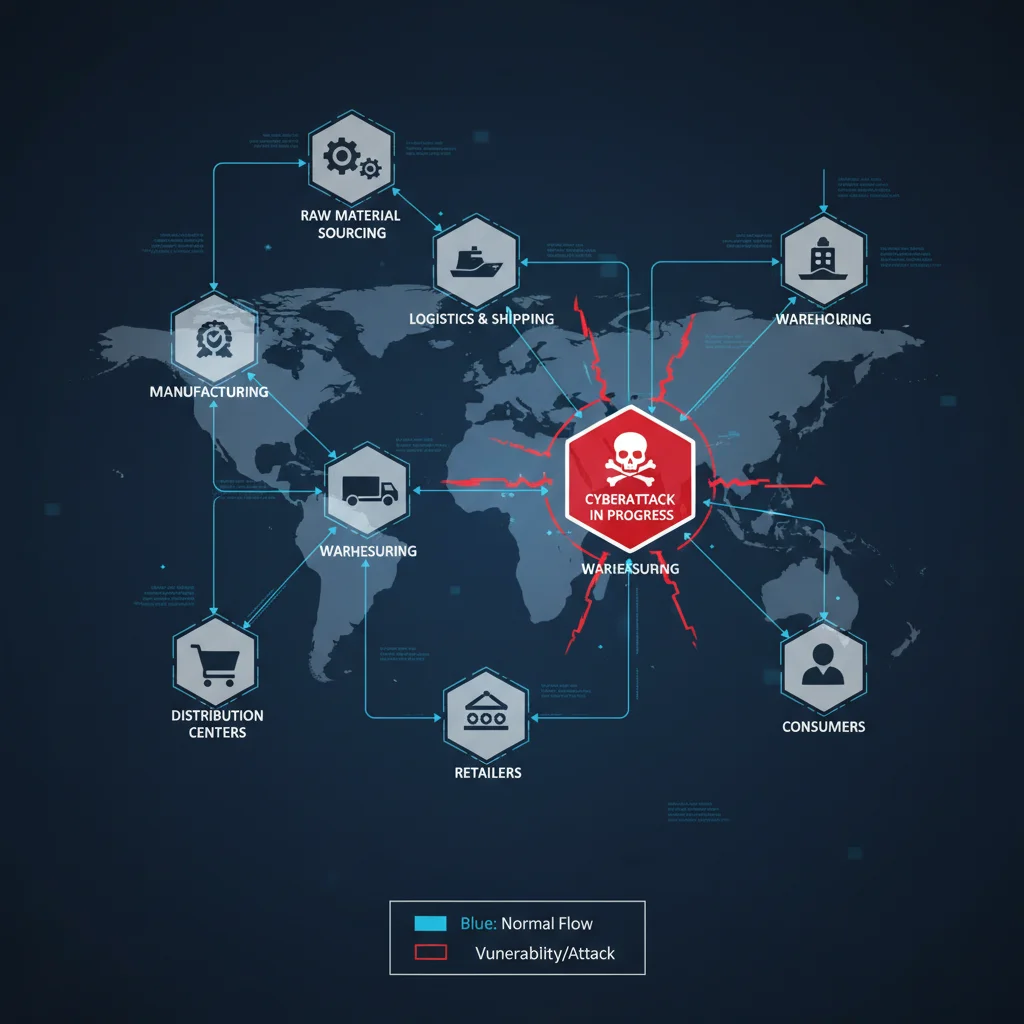
The interconnected nature of modern business means that organizations rarely operate in isolation. They rely on a complex web of third-party vendors, suppliers, and service providers. This supply chain has become a lucrative target for attackers seeking to compromise a high-value target indirectly. By 2027, supply chain attacks will be even more pervasive and sophisticated, making them a top concern among advanced cybersecurity threats.
Exploiting the Weakest Link
Attackers will continue to target smaller, less secure vendors in a supply chain to gain access to larger, more secure enterprises. Examples like the SolarWinds attack demonstrated the devastating potential of compromising a widely used software component. Future attacks could involve:
- Software Supply Chain Poisoning: Injecting malicious code into legitimate software updates, open-source libraries, or development tools.
- Hardware Tampering: Introducing backdoors or vulnerabilities during the manufacturing or distribution of hardware components.
- Service Provider Breaches: Compromising managed service providers (MSPs) or cloud service providers (CSPs) to gain access to multiple client environments simultaneously.
- Data Integrity Attacks: Manipulating data within the supply chain to cause operational disruption or financial fraud.
Mitigating supply chain risks requires a multi-faceted approach. U.S. organizations must implement rigorous vendor risk management programs, including comprehensive security assessments, contractual obligations for cybersecurity standards, and continuous monitoring of third-party security postures. Furthermore, adopting a ‘zero-trust’ architecture, where no entity is trusted by default, regardless of its location or previous access, can help contain the damage from a compromised supplier. Visibility into the entire supply chain, from raw materials to final product, will become increasingly crucial.
Threat 4: Blended Ransomware 2.0 and Extortion Tactics
Ransomware has already proven to be one of the most disruptive and costly cyber threats. By 2027, ransomware will have evolved into ‘Ransomware 2.0,’ a blended threat combining encryption with advanced extortion tactics, data exfiltration, and targeted disruption. These advanced cybersecurity threats will be even more difficult to defend against and recover from.
Multi-Layered Extortion
Attackers will increasingly employ multi-layered extortion strategies:
- Double Extortion: Encrypting data AND exfiltrating it, threatening to publish or sell the stolen information if the ransom is not paid.
- Triple Extortion: Adding a third layer by launching DDoS attacks against the victim’s public-facing services, notifying customers/partners of the breach, or directly contacting shareholders.
- Reputational Damage: Threatening to leak embarrassing internal communications or sensitive customer data to damage the organization’s public image.
- Operational Disruption: Targeting critical operational technology (OT) systems to cause physical damage or widespread service outages, demanding ransom to restore functionality.
To combat Ransomware 2.0, U.S. organizations need more than just robust backups. They require comprehensive incident response plans that account for data exfiltration, communication strategies for public relations, and the ability to operate in a degraded state. Stronger endpoint detection and response (EDR) solutions, network segmentation, immutable backups, and regular security awareness training for employees are vital. Furthermore, proactive threat hunting to identify potential ransomware entry points before an attack materializes will be key.
Threat 5: State-Sponsored Cyber Warfare and Critical Infrastructure Targeting
The geopolitical landscape is increasingly intertwined with cyber warfare. Nation-states will continue to escalate their cyber capabilities, and by 2027, state-sponsored cyberattacks will be more frequent, sophisticated, and destructive, particularly targeting critical infrastructure within the U.S. These represent some of the most dangerous advanced cybersecurity threats due to their potential for widespread societal impact.
Strategic Sabotage and Espionage
Motivations for state-sponsored attacks include:
- Espionage: Stealing sensitive government information, military intelligence, and corporate intellectual property to gain economic or strategic advantage.
- Sabotage: Disrupting critical national infrastructure (e.g., energy grids, water treatment plants, transportation systems, healthcare) to sow chaos, exert political pressure, or prepare for conventional conflict.
- Propaganda and Disinformation: Manipulating public opinion through sophisticated online campaigns, often involving deepfakes and AI-generated content.
- Pre-positioning: Infiltrating systems and establishing persistent access for future use, lying dormant until activated for a specific objective.
Defending against state-sponsored actors requires a coordinated effort between government agencies and private sector organizations. U.S. critical infrastructure operators must adopt an ‘assume breach’ mentality, focusing on detection and rapid response. This includes implementing advanced threat intelligence sharing, employing highly specialized security teams (red and blue teams), and investing in industrial control system (ICS) security. Regular simulations and tabletop exercises to test incident response plans against realistic state-sponsored attack scenarios are also essential to build resilience.
Building a Resilient Defense: Strategies for U.S. Organizations
Facing these advanced cybersecurity threats requires more than just patching vulnerabilities; it demands a strategic overhaul of an organization’s security posture. Here are key strategies U.S. organizations should prioritize:
1. Adopt a Zero-Trust Architecture
Move away from traditional perimeter-based security. Implement zero-trust principles where no user, device, or application is inherently trusted, regardless of its location. Verify everything, enforce least privilege access, and continuously monitor for suspicious activity.
2. Invest in Advanced Threat Intelligence
Proactively gather and analyze threat intelligence from various sources – government agencies, industry peers, and cybersecurity vendors. Understanding the tactics, techniques, and procedures (TTPs) of potential adversaries is crucial for anticipating and defending against future attacks.
3. Enhance AI/ML-Driven Security Solutions
Leverage AI and machine learning for automated threat detection, behavioral analytics, anomaly detection, and rapid incident response. These tools can process vast amounts of data and identify threats at speeds impossible for human analysts alone.
4. Prioritize Human Capital and Training
Technology alone is insufficient. Invest in continuous training for your cybersecurity team to ensure they are skilled in the latest defensive techniques and understand emerging threats. Cultivate a security-aware culture across the entire organization through regular employee training.
5. Develop Robust Incident Response and Recovery Plans
Assume that a breach is inevitable. Develop, regularly test, and refine comprehensive incident response plans that cover detection, containment, eradication, recovery, and post-incident analysis. This includes robust data backup and recovery strategies, especially immutable backups for ransomware defense.
6. Strengthen Supply Chain Security
Implement stringent vendor risk management programs. Conduct thorough security assessments of all third-party suppliers and critically evaluate their security posture. Demand transparency and accountability throughout your supply chain.
7. Embrace Post-Quantum Cryptography (PQC) Planning
Begin the process of evaluating and planning for the transition to quantum-resistant encryption algorithms. While the full impact of quantum computing is still some years away, early preparation is essential to protect long-term data confidentiality.
8. Foster Collaboration and Information Sharing
Engage with industry-specific information sharing and analysis centers (ISACs/ISAOs), government agencies (like CISA), and peer organizations. Sharing threat intelligence and best practices is vital in a collective defense against sophisticated adversaries.
The Path Forward: Proactive Defense Against Advanced Cybersecurity Threats
The cybersecurity landscape of 2027 will be characterized by a relentless and sophisticated adversary. The five advanced cybersecurity threats outlined – hyper-sophisticated AI-powered attacks, quantum computing’s cryptographic challenge, widespread supply chain compromises, blended Ransomware 2.0, and escalated state-sponsored cyber warfare – demand immediate and sustained attention from U.S. organizations.
Ignoring these warnings is not an option. The organizations that thrive in this future will be those that embrace a proactive, adaptive, and intelligence-driven cybersecurity strategy. It requires a commitment to continuous improvement, significant investment in both technology and human expertise, and a willingness to collaborate across sectors. By preparing today, U.S. organizations can transform potential vulnerabilities into robust defenses, safeguarding their assets, their operations, and their future in the increasingly complex digital world.
The journey to enhanced cybersecurity resilience by 2027 is challenging, but it is also an opportunity to build stronger, more secure digital foundations. The time to act is now.