Visual Thinking Strategies: 8 Techniques US Educators Use for Creative Problem-Solving

In the dynamic landscape of modern education, fostering not just knowledge acquisition but also critical thinking and creative problem-solving is paramount. As US educators continually seek innovative methodologies to engage students and equip them with essential 21st-century skills, Visual Thinking Strategies (VTS) have emerged as a powerful pedagogical tool. These strategies transcend traditional learning by encouraging students to interpret, analyze, and communicate complex ideas through visual means, thereby unlocking deeper levels of comprehension and fostering innovative thought processes.
The human brain is inherently wired for visual processing. From interpreting complex data visualizations to understanding narrative through imagery, our minds naturally gravitate towards visual information. Recognizing this fundamental aspect of human cognition, educators are increasingly integrating VTS into their curricula. This approach not only caters to diverse learning styles but also trains students to observe keenly, articulate thoughtfully, and construct meaning collaboratively. By moving beyond rote memorization and towards active visual engagement, VTS empowers students to become more independent thinkers and creative problem-solvers.
This year, a growing number of US educators are championing VTS, observing significant improvements in student engagement, critical analysis, and collaborative skills. These strategies are not limited to art classes; they are being successfully implemented across various subjects, from science and mathematics to history and literature. The beauty of VTS lies in their versatility and their capacity to make abstract concepts tangible, fostering a more inclusive and stimulating learning environment. Let’s delve into eight specific Visual Thinking Strategies that US educators are employing to enhance creative problem-solving skills in their students.
1. See, Think, Wonder: The Foundation of Visual Inquiry
The ‘See, Think, Wonder’ strategy, a cornerstone of Visual Thinking Strategies, encourages students to meticulously observe an image or artifact before jumping to conclusions. This simple yet profound technique cultivates careful observation, critical thinking, and the formulation of insightful questions. Students are first asked, ‘What do you see?’ prompting them to identify concrete details without interpretation. This initial step is crucial for developing visual literacy.
Next, they move to ‘What do you think is going on?’ This encourages them to make inferences, construct narratives, and develop hypotheses based on their observations. This stage is where creative problem-solving begins to take shape, as students connect observed details to broader meanings and potential scenarios. Finally, ‘What does it make you wonder?’ pushes them to formulate questions, identify ambiguities, and explore further avenues of inquiry. This fosters intellectual curiosity and a desire for deeper understanding.
US educators use this technique with historical photographs, scientific diagrams, pieces of art, or even complex infographics. By systematically breaking down their engagement with visual information, students learn to approach problems with a structured yet imaginative mindset. This strategy is particularly effective in subjects like history, where analyzing primary source images can reveal nuances often missed in textual accounts, or in science, where interpreting experimental data visualizations requires careful observation and inferential reasoning. The structured approach of ‘See, Think, Wonder’ makes it an accessible entry point for students to engage with Visual Thinking Strategies and build foundational skills for complex problem-solving.
2. Mind Mapping: Connecting Ideas Visually
Mind mapping is a highly effective Visual Thinking Strategy that helps students organize information, generate ideas, and understand complex relationships. It involves drawing a central idea or topic, and then branching out with related concepts, keywords, images, and colors. This non-linear approach mirrors the brain’s natural way of thinking, making it a powerful tool for brainstorming and problem-solving.
Educators use mind mapping to help students outline essays, plan projects, analyze literary themes, or even break down scientific processes. For instance, in a history class, students might create a mind map about the causes of a war, with each branch representing a different contributing factor and sub-branches detailing specific events or figures. In a science class, a mind map could illustrate the components of an ecosystem and their interdependencies.
The visual nature of mind maps aids memory retention and allows students to see the ‘big picture’ while also understanding the intricate connections between individual pieces of information. This encourages creative associations and helps students identify gaps in their understanding, leading to more comprehensive and innovative solutions to problems. The act of creating a mind map is itself a problem-solving exercise, as students must decide how to categorize, prioritize, and link information effectively. This strategy is an excellent way to harness Visual Thinking Strategies for both individual and collaborative learning.
3. Sketch-noting and Visual Note-Taking: Enhancing Comprehension and Recall
Moving beyond traditional linear note-taking, sketch-noting and visual note-taking are dynamic Visual Thinking Strategies that combine text with drawings, symbols, and visual metaphors. This method engages multiple parts of the brain, leading to improved comprehension, memory retention, and creative synthesis of information.
When students sketch-note, they are actively processing information, translating abstract concepts into visual representations. This forces them to distill complex ideas into their essence, which is a critical skill for problem-solving. For example, during a lecture on economics, a student might draw a simple graph to represent supply and demand, or a series of interconnected gears to illustrate the workings of a market. These visual cues serve as powerful memory triggers and help in recalling information more effectively than plain text.
US educators are encouraging students to adopt this practice in various subjects. In a literature class, students might sketch characters or plot developments. In a math class, they could visually represent problem steps. By actively creating their own visual language, students not only personalize their learning experience but also develop a unique way of understanding and solving problems. This strategy is particularly vital in an age where information overload is common, as it helps students filter, organize, and make sense of vast amounts of data using effective Visual Thinking Strategies.
4. Graphic Organizers: Structuring Thought for Clarity
Graphic organizers are visual frameworks that help students organize information and ideas in a structured way. They come in many forms, such as Venn diagrams, flowcharts, T-charts, KWL charts (Know, Want to Know, Learned), and cause-and-effect diagrams. These tools are indispensable Visual Thinking Strategies for clarifying complex relationships and facilitating logical thought processes.
For example, a Venn diagram can help students compare and contrast two concepts, highlighting their similarities and differences. A flowchart can map out a process or a sequence of events, making it easier to understand cause and effect. KWL charts are excellent for activating prior knowledge, setting learning goals, and summarizing new information. These organizers provide a visual scaffold that supports students in breaking down complex problems into manageable parts.
US educators utilize graphic organizers across the curriculum to enhance problem-solving. In science, a flowchart might illustrate the steps of the water cycle. In social studies, a cause-and-effect diagram could explain the origins and consequences of a historical event. By providing a clear visual structure, graphic organizers help students think more systematically, identify patterns, and articulate their understanding with greater precision. This systematic approach is a hallmark of effective Visual Thinking Strategies for developing robust problem-solving skills.

5. Visual Metaphors and Analogies: Bridging Abstract and Concrete
The use of visual metaphors and analogies is a powerful Visual Thinking Strategy that helps students understand abstract or complex concepts by relating them to something familiar and concrete. This technique involves representing an idea not literally, but through an image that shares similar characteristics or functions. It’s about making the intangible tangible.
For instance, an educator might ask students to draw what a ‘strong argument’ looks like. Some might draw a fortress, others a sturdy bridge, or a tree with deep roots. Each visual metaphor provides a unique perspective on the concept of strength in argument. Similarly, explaining the circulatory system as a ‘highway network’ within the body uses a visual analogy that students can easily grasp.
This strategy encourages creative thinking and helps students build deeper connections between new information and their existing knowledge base. When students are prompted to create their own visual metaphors, they engage in a high level of cognitive processing, translating abstract ideas into personally meaningful images. This not only aids comprehension but also fosters innovative approaches to problem-solving, as they learn to see connections where none were immediately apparent. US educators find this particularly useful in subjects like philosophy, literature, and even advanced scientific concepts, making Visual Thinking Strategies a cornerstone of conceptual understanding.
6. Storyboarding: Visualizing Processes and Narratives
Storyboarding is a dynamic Visual Thinking Strategy that involves creating a sequence of images or drawings to outline a narrative, process, or series of events. Originally used in animation and film, it’s now a versatile educational tool for planning, problem-solving, and communicating ideas in a clear, sequential manner.
In the classroom, students can use storyboards to plan a science experiment, illustrate the steps of a mathematical proof, outline a historical event, or even develop a creative writing piece. For example, a group of students might storyboard the life cycle of a butterfly, depicting each stage with a simple drawing and a brief description. Another application could be to visualize the stages of an engineering design process, from ideation to testing.
This strategy helps students organize their thoughts chronologically and spatially, making complex processes easier to understand and remember. It also encourages them to think about cause and effect, transitions, and the overall flow of information. By visualizing each step, students can identify potential problems or inefficiencies in their plan before execution, thereby enhancing their problem-solving capabilities. Storyboarding is an excellent way to integrate narrative thinking with visual organization, making it a powerful component of Visual Thinking Strategies.
7. Visual Puzzles and Challenges: Engaging Critical Observation
Visual puzzles and challenges are engaging Visual Thinking Strategies designed to sharpen students’ observational skills, critical analysis, and deductive reasoning. These activities often involve examining an image with hidden elements, discrepancies, or a problem that needs to be solved purely through visual clues.
Examples include ‘spot the difference’ games (but with more complex images and subtle changes), analyzing optical illusions, deciphering historical maps for clues, or interpreting complex scientific diagrams to identify anomalies. Educators might present a crime scene illustration and ask students to identify suspects based on visual evidence, or provide an image of an intricate machine and challenge them to explain its function based on its components.
These exercises compel students to pay close attention to detail, make connections between disparate visual elements, and formulate logical deductions. They move beyond superficial viewing to deep observation, a crucial skill for both academic success and real-world problem-solving. By consistently engaging with visual challenges, students develop a keen eye for detail and an improved ability to extract meaningful information from visual data, reinforcing the power of Visual Thinking Strategies in developing analytical minds.
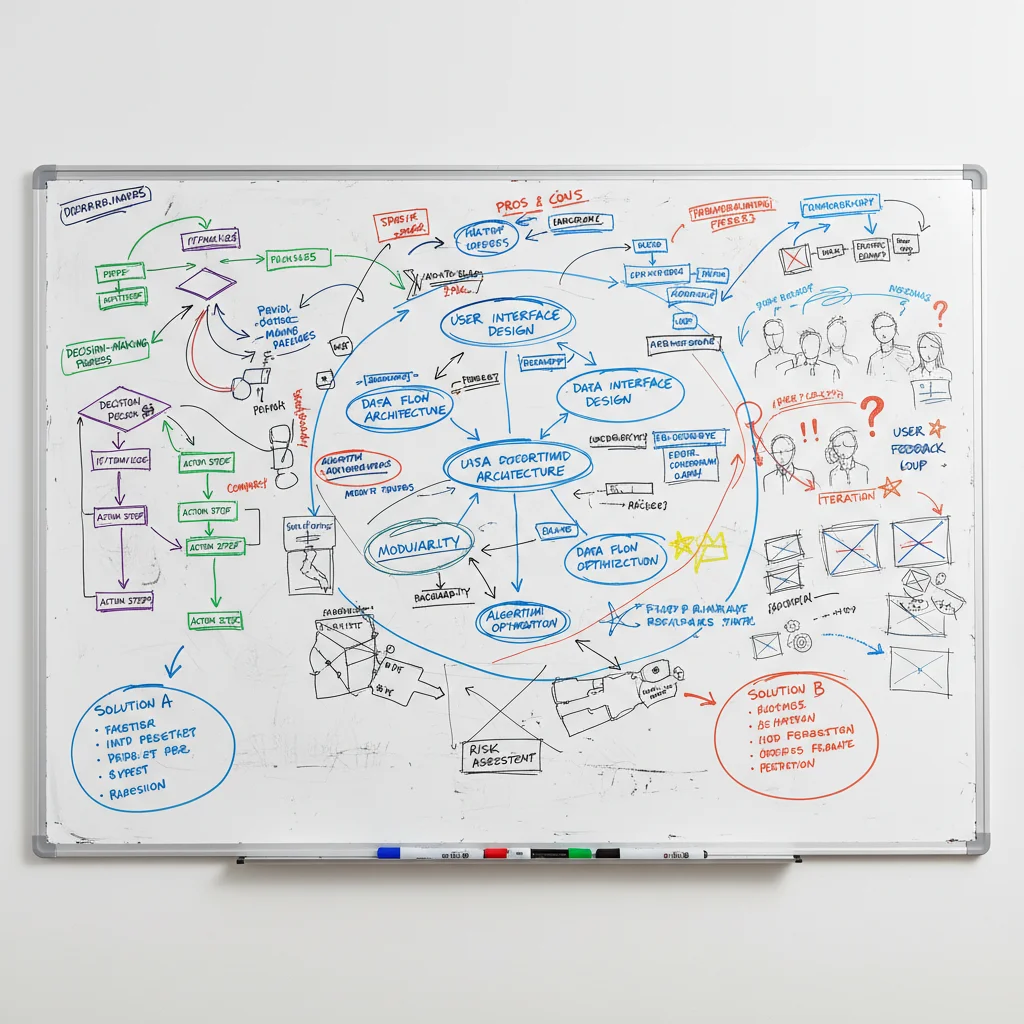
8. Collaborative Drawing and Visual Brainstorming: Shared Creative Problem-Solving
Collaborative drawing and visual brainstorming are highly interactive Visual Thinking Strategies that leverage the power of group dynamics to generate and refine ideas. Instead of individual work, students collectively contribute to a shared visual space, such as a large whiteboard, a digital canvas, or even a communal sheet of paper, to solve a problem or develop a concept.
In this strategy, students might be given a problem – for example, ‘Design a sustainable city’ or ‘Illustrate the concept of democracy’ – and then work together, drawing, sketching, and annotating their ideas. One student might draw a building, another might add solar panels, while a third might draw a public transport system, all contributing to a evolving visual solution. The process is iterative and dynamic, encouraging immediate feedback and refinement.
This approach fosters communication, teamwork, and the ability to build upon each other’s ideas in a visual medium. It allows for the rapid exploration of multiple perspectives and solutions, often leading to more creative and comprehensive outcomes than individual efforts. US educators find this strategy particularly effective for complex, open-ended problems that benefit from diverse viewpoints and collective intelligence. By making thinking visible and collaborative, these Visual Thinking Strategies empower students to not only solve problems together but also to understand and appreciate different approaches to creative thinking.
The Broader Impact of Visual Thinking Strategies in Education
The integration of Visual Thinking Strategies into the curriculum extends far beyond the immediate benefits of improved problem-solving. These techniques cultivate a range of essential skills that prepare students for success in an increasingly visual and information-rich world. By regularly engaging with visual information, students develop enhanced visual literacy, which is the ability to interpret, understand, and create visual content. In an era dominated by digital media, this skill is as critical as traditional literacy.
Moreover, VTS promotes metacognition, as students become more aware of their own thought processes. When they articulate what they ‘see’ and ‘think,’ they are reflecting on their observations and interpretations, leading to deeper self-awareness in their learning journey. This reflective practice is vital for continuous improvement and adaptability, key traits of effective problem-solvers.
Another significant impact is the enhancement of communication skills. Explaining visual observations and interpretations requires precise language and the ability to articulate complex ideas clearly. Students learn to present their reasoning logically and persuasively, whether verbally or in writing, often using their visual aids as a foundation for their arguments. This bridges the gap between visual understanding and articulate expression, a crucial aspect of academic and professional success.
Furthermore, VTS fosters inclusivity in the classroom. Students who may struggle with traditional text-based learning often thrive when given opportunities to express themselves visually. This can build confidence, reduce anxiety, and create a more equitable learning environment where diverse intelligences are recognized and valued. By providing multiple pathways to understanding and expression, Visual Thinking Strategies ensure that all students have the opportunity to engage deeply with content and showcase their unique talents.
The emphasis on creative problem-solving through VTS also aligns perfectly with the demands of the modern workforce. Industries across sectors, from technology and design to healthcare and business, increasingly value employees who can think creatively, innovate, and solve complex, unstructured problems. By nurturing these skills from an early age, US educators are not just preparing students for tests, but for successful and impactful careers in a rapidly evolving global economy.
In conclusion, the adoption of these eight Visual Thinking Strategies by US educators represents a progressive shift towards a more holistic and effective approach to teaching and learning. By leveraging the brain’s natural capacity for visual processing, these strategies empower students to observe, analyze, synthesize, and communicate with greater clarity and creativity. As we continue to navigate a world that requires innovative solutions to complex challenges, the ability to think visually will undoubtedly remain a cornerstone of effective education and lifelong learning.