Creative Synthesis: 3 Methods US Companies Are Using to Combine Disparate Concepts for Novel Solutions in 2026
In the rapidly evolving landscape of 2026, where technological advancements and market demands shift at an unprecedented pace, US companies are increasingly recognizing that conventional problem-solving approaches are no longer sufficient. The key to sustained growth and competitive advantage lies in the ability to generate truly novel solutions, and this is where Creative Synthesis Methods come into play. Creative synthesis is not merely about brainstorming; it’s a structured and often intentional process of combining seemingly unrelated ideas, concepts, or technologies to forge something entirely new and impactful. This deep dive explores three prominent creative synthesis methods that US companies are championing to unlock unparalleled innovation.
The concept of creative synthesis is rooted in the understanding that innovation often emerges at the intersection of disciplines. By deliberately bringing together disparate elements, organizations can break free from conventional thinking, challenge assumptions, and discover unforeseen opportunities. This article will unpack how US companies are implementing these methods, offering insights into their practical application and the transformative results they are yielding.
The Imperative for Creative Synthesis in 2026
The business environment of 2026 is characterized by hyper-connectivity, rapid technological advancement, and a global marketplace that demands constant reinvention. Companies that fail to innovate risk obsolescence. This pressure has led to a significant shift in how organizations approach R&D and product development. Instead of incremental improvements, there’s a push for disruptive innovation. Creative Synthesis Methods provide the frameworks necessary to achieve this. They encourage a mindset that values exploration, experimentation, and the cross-pollination of ideas from various domains.
Consider the rise of AI and machine learning, quantum computing, and advanced biotechnologies. These fields, while distinct, are increasingly converging to create hybrid solutions that were unimaginable just a few years ago. For instance, combining AI with biotechnology can lead to personalized medicine that is far more effective than traditional treatments. Similarly, integrating IoT with sustainable energy solutions can create smart grids that optimize energy consumption on a massive scale. These are not simple additive processes; they are acts of creative synthesis, where the whole becomes greater than the sum of its parts.
US companies, known for their entrepreneurial spirit and drive for innovation, are at the forefront of adopting these sophisticated techniques. They understand that the future belongs to those who can not only adapt but also proactively shape it through inventive solutions. The following sections detail three key Creative Synthesis Methods that are proving particularly effective.
Method 1: Cross-Pollination Through Interdisciplinary Design Sprints
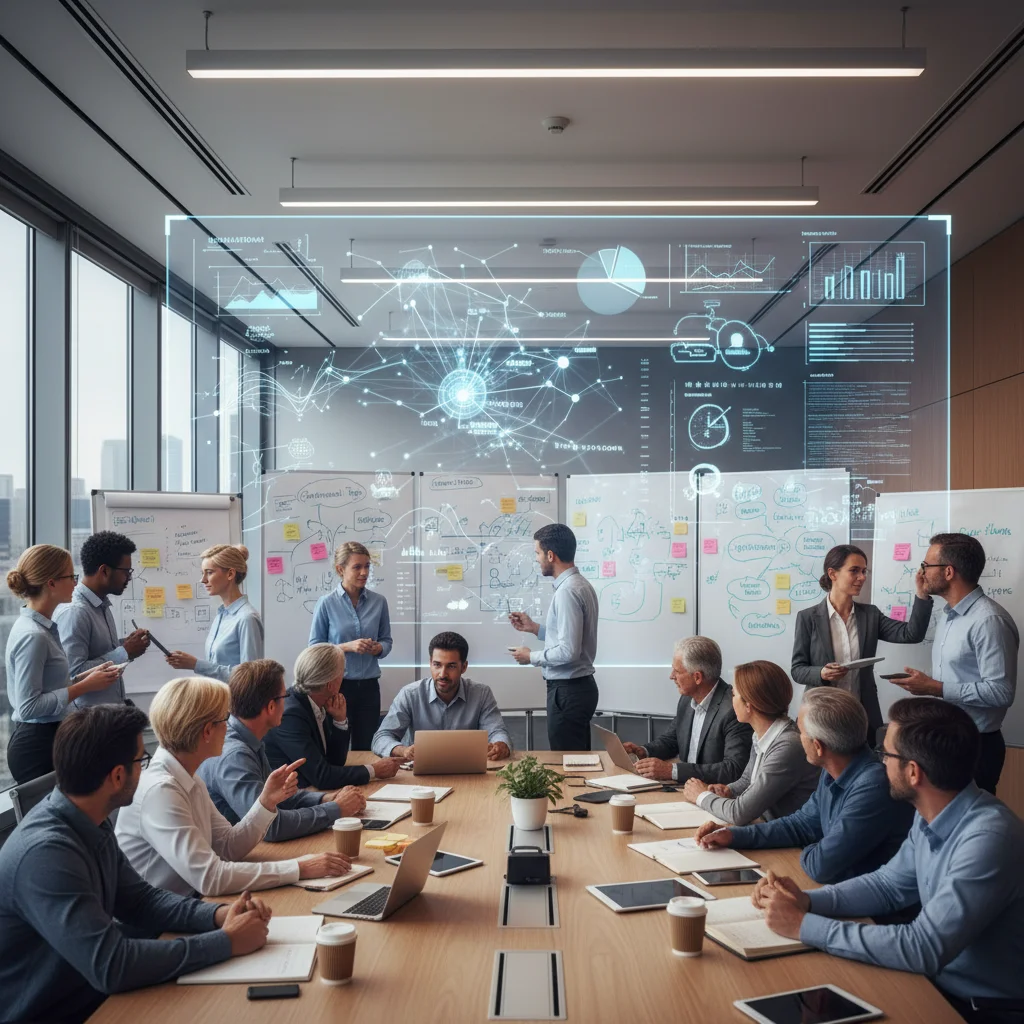
One of the most effective Creative Synthesis Methods being employed by US companies in 2026 is the interdisciplinary design sprint. This method involves bringing together diverse teams from different departments, or even different industries, to tackle a specific challenge within a compressed timeframe, typically five days. The goal is to rapidly ideate, prototype, and test solutions by leveraging the varied perspectives and expertise present in the room.
What are Interdisciplinary Design Sprints?
A design sprint, popularized by Google Ventures, is an intensive, five-phase process: Map, Sketch, Decide, Prototype, and Test. The ‘interdisciplinary’ aspect amplifies its power by ensuring that participants come from a wide range of backgrounds – engineers, marketers, designers, data scientists, ethicists, and even external experts or customers. This deliberate mix prevents groupthink and encourages the fusion of disparate ideas. For example, a tech company might include a psychologist to understand user behavior, an artist for creative problem framing, and a logistics expert for supply chain implications, all contributing to a new product’s development.
How US Companies are Implementing Them
Leading US companies like IDEO, often cited for their design thinking methodologies, have long championed similar approaches. In 2026, this has evolved to include more robust digital collaboration tools and remote participation, allowing for an even wider pool of diverse talent. Companies are forming ‘innovation hubs’ where these sprints are a regular occurrence, fostering a culture of continuous creative synthesis. For instance, a major automotive manufacturer might conduct a sprint involving urban planners, software developers, and material scientists to reimagine future mobility solutions, combining concepts from smart city infrastructure, autonomous driving, and sustainable materials.
The success of these sprints lies in their structured yet flexible nature. They provide a clear framework for problem-solving while allowing ample space for unconventional ideas to emerge. The rapid prototyping phase is crucial, as it quickly validates or invalidates concepts, preventing significant investment in unviable solutions. This iterative process, infused with diverse viewpoints, is a powerful engine for Creative Synthesis Methods.
Method 2: Analogical Thinking and Biomimicry
Another potent creative synthesis method gaining traction in US businesses is analogical thinking, particularly biomimicry. This approach involves drawing inspiration from solutions found in nature or from unrelated domains to solve current challenges. It’s about recognizing patterns and principles in one context and applying them creatively to another.
Understanding Analogical Thinking and Biomimicry
Analogical thinking is a cognitive process where information from one domain (the source) is used to solve a problem in another domain (the target). Biomimicry is a specific form of analogical thinking where nature serves as the ultimate source of inspiration. Billions of years of evolution have led to highly optimized designs and processes in the natural world. By studying these, companies can find elegant and sustainable solutions to complex engineering, design, and organizational problems.
For example, observing how a kingfisher’s beak reduces splash upon entering water inspired the design of a Japanese bullet train’s nose cone, significantly reducing noise and air resistance. This is a classic example of biomimicry leading to a novel solution through creative synthesis.
Applications in US Companies for 2026
In 2026, US companies are moving beyond superficial biomimicry to a deeper integration of natural principles. Material science companies are developing self-healing polymers inspired by biological processes, while architectural firms are designing buildings that regulate temperature and airflow like termite mounds. Software developers are even exploring algorithms inspired by ant colony optimization for efficient network routing.
Beyond biomimicry, companies are actively seeking analogies from vastly different industries. A healthcare provider might look at how logistics companies optimize supply chains to improve patient flow. A financial institution might study gaming psychology to enhance user engagement with their digital platforms. This deliberate search for non-obvious connections is a cornerstone of effective Creative Synthesis Methods. Companies are establishing dedicated ‘analogy labs’ or partnering with research institutions specializing in cross-domain knowledge transfer to facilitate this process. The emphasis is on abstracting core principles rather than direct copying, allowing for truly transformative adaptations.
Method 3: AI-Driven Concept Blending and Generative Design
Perhaps the most cutting-edge of the Creative Synthesis Methods emerging in 2026 is AI-driven concept blending and generative design. Artificial intelligence is no longer just for automation; it’s becoming a powerful partner in the creative process, capable of processing vast amounts of information and identifying novel combinations that human minds might overlook.
The Role of AI in Creative Synthesis
AI algorithms, particularly those leveraging neural networks and machine learning, can analyze massive datasets of existing designs, patents, scientific papers, and market trends. They can then identify latent connections, predict emerging patterns, and even generate entirely new conceptual blends. This is not about AI replacing human creativity, but augmenting it. AI can act as a tireless assistant, exploring billions of permutations of ideas and presenting the most promising ones for human evaluation and refinement.
Generative design, a subset of AI-driven concept blending, allows designers to input specific parameters and constraints (e.g., strength, weight, material, manufacturing cost). The AI then autonomously explores countless design options, often producing forms and structures that are highly optimized and aesthetically unique, far beyond what a human designer could conceive in the same timeframe. This is particularly valuable in fields like aerospace, automotive, and architecture.
Real-World Impact in US Industry
In 2026, major US tech giants and even smaller innovative startups are heavily investing in AI for creative synthesis. For example, pharmaceutical companies are using AI to blend chemical compounds and predict novel drug candidates with higher efficacy and fewer side effects. Fashion brands are using AI to combine fabric textures, patterns, and historical trends to generate new clothing lines. Manufacturing companies are employing generative design to create lighter, stronger, and more cost-effective components for everything from medical implants to vehicle chassis.
The power of AI in these Creative Synthesis Methods lies in its ability to operate without human biases or preconceptions. It can make connections between data points that appear entirely unrelated to the human eye, surfacing true breakthrough innovations. Furthermore, AI can accelerate the ideation phase dramatically, allowing companies to explore a wider range of possibilities before committing resources to development. This synergistic relationship between human creativity and artificial intelligence is reshaping the future of innovation.
Challenges and Best Practices in Implementing Creative Synthesis Methods
While the benefits of Creative Synthesis Methods are clear, their successful implementation is not without challenges. Companies must navigate cultural resistance, resource allocation, and the inherent uncertainty of innovative endeavors.
Overcoming Obstacles
One major hurdle is organizational culture. Many traditional companies are risk-averse and prefer incremental improvements over radical departures. Fostering a culture that embraces experimentation, tolerates failure, and values diverse perspectives is paramount. This often requires strong leadership buy-in and a clear communication strategy that emphasizes the long-term benefits of creative synthesis.
Another challenge is resource allocation. Interdisciplinary teams require dedicated time and space, and AI tools demand significant investment in infrastructure and talent. Companies must be prepared to allocate resources strategically, viewing these as investments in future growth rather than mere expenses.
Best Practices for Success
- Cultivate a Culture of Curiosity: Encourage employees to explore ideas outside their immediate domain. Organize internal ‘innovation fairs’ or ‘hackathons’ that promote cross-functional collaboration and idea sharing.
- Invest in Training and Tools: Provide training in design thinking, analogical reasoning, and prompt engineering for AI tools. Equip teams with collaborative platforms and access to advanced AI resources.
- Embrace Structured Experimentation: Implement design sprints or similar structured methodologies to guide the creative process. Define clear objectives but allow for serendipitous discoveries.
- Seek External Perspectives: Partner with universities, startups, or even competitors in non-competing areas to bring fresh viewpoints. Attend industry conferences that cut across traditional sectors.
- Measure and Iterate: Establish metrics for innovation, not just financial returns. Track the number of novel ideas generated, prototypes developed, and lessons learned. Continuously refine the creative synthesis process based on feedback.
By adhering to these best practices, US companies can mitigate risks and maximize the potential of their Creative Synthesis Methods, transforming challenges into opportunities for groundbreaking innovation.
The Future of Innovation: A Synthesized World
As we look further into the future, beyond 2026, the integration of Creative Synthesis Methods will become even more seamless and pervasive. We can anticipate a future where AI not only assists in blending concepts but also autonomously identifies problems and proposes solutions, leading to a new era of ‘proactive innovation’. The lines between industries will continue to blur, driven by cross-pollination and the search for novel applications of existing technologies.
Imagine a scenario where a company specializing in sustainable materials collaborates with a space exploration firm, guided by AI, to develop self-repairing habitats for other planets, drawing inspiration from extremophiles found in Earth’s deepest oceans. This is the promise of creative synthesis – a world where the seemingly impossible becomes achievable through the intelligent combination of disparate elements.
US companies are setting the global standard in this pursuit, understanding that the capacity for creative synthesis is not just a competitive advantage but a fundamental requirement for thriving in the 21st century. By mastering interdisciplinary design sprints, leveraging analogical thinking and biomimicry, and harnessing the power of AI-driven concept blending, they are not just responding to change; they are actively creating the future.
Conclusion: Unlocking Untapped Potential with Creative Synthesis Methods
The journey towards sustained innovation is complex, but the strategic application of Creative Synthesis Methods offers a clear pathway forward. US companies in 2026 are demonstrating that by intentionally combining disparate concepts, they can unlock unprecedented levels of creativity and generate truly novel solutions. Whether through the structured chaos of interdisciplinary design sprints, the profound wisdom of nature found in biomimicry, or the limitless possibilities offered by AI-driven concept blending, these methods are proving to be indispensable tools in the innovator’s arsenal.
For any organization looking to stay ahead of the curve, embracing and integrating these approaches is no longer optional; it’s a strategic imperative. The ability to see connections where others see none, to fuse ideas that were once separate, and to build something entirely new from diverse components is the hallmark of true innovation. As the world continues to accelerate, the companies that master Creative Synthesis Methods will be the ones that not only survive but thrive, leading the charge into an exciting, innovated future.